Continuous Testing That Improves Every Release
Validate your product at every stage of development. With 120,000 testers in 150 countries,
Ubertesters brings real-world feedback into your CI/CD pipelines so you can
catch issues early, release faster, and deliver reliable experiences from the first commit
to production. Our global testers surface the problems automation often misses,
ensuring every build ships with confidence.

Trusted by some of the world's smartest companies
Trusted by the world's top companies














At a Glance: Continuous Testing, Everywhere
- 120,000 verified testers
- ~600,000 real devices
- 150 countries
- Continuous testing support across all SDLC stages
- Real users validating every build, sprint and release
- Fast feedback loops directly into your CI/CD pipeline
- Manual and exploratory testing to complement automation
- Coverage across devices, networks, regions and real user conditions
What is Continuous Testing in SDLC?
Every delay in finding a bug costs you more than just time. What starts as a tiny oversight in early development can turn into a production issue that drains budget, frustrates users, and damages your team’s confidence. Too often, testing comes in late, after the code is written, when deadlines are tight, and every fix feels like an emergency patch. That’s not testing, that’s damage control. The smarter way is to build quality in from the start.
What Continuous Testing Means
Continuous testing changes this model. Instead of waiting for a specific testing phase, you validate your software constantly throughout development, as part of the delivery pipeline. The goal is to receive rapid feedback on business risks associated with each release, in every sprint and every build.
Continuous Testing (CT) is the practice of validating code quality, functionality, performance, and user experience across all stages of the Software Development Lifecycle (SDLC) — from the first commit to post-production monitoring.
How it Differs from Traditional Testing:
Traditional testing usually takes place at the end of the development process. Continuous testing follows a “shift-left” approach, moving testing activities earlier in the DevOps pipeline. The earlier an issue is found, the faster and cheaper it is to fix before it reaches your users.


Why Manual Testing Matters in CI/CD
Automation drives speed in CI/CD, but it has limits. Automation cannot replicate real user behavior, handle complex flows, detect subtle usability issues, or account for the diversity of global devices and network conditions. Automation can confirm that a button works, but not whether users understand what to do next. It cannot reveal an app crash on a specific device model in a specific region.
Continuous crowd testing closes this gap. It combines the speed of CI/CD with real human insight under real-world conditions. It is where “shift-left testing” meets authentic user experience. Think of it as having hundreds of QA experts available across devices, networks, countries, and user behaviors, ready to test as soon as new code is deployed.
Why Continuous Testing Matters
In the era of rapid release cycles and demanding users, software quality cannot be a last-minute checkpoint. Continuous Testing throughout the SDLC ensures that every change is validated early and often, reducing release risk by up to 80% and accelerating time-to-market.
Relying solely on automation is a critical quality gap. Your customers aren’t scripts; they’re people. Only human insight can capture the emotional, contextual, and cultural dimensions of user experience.
This is where Ubertesters adds meaningful impact. We integrate continuous, global, real-user testing throughout your SDLC, providing the combination of speed, quality, and real-world insight that automation alone can’t deliver. Your pipeline becomes a living feedback loop that never stops improving your product.
Secure Quality, Simplified Testing
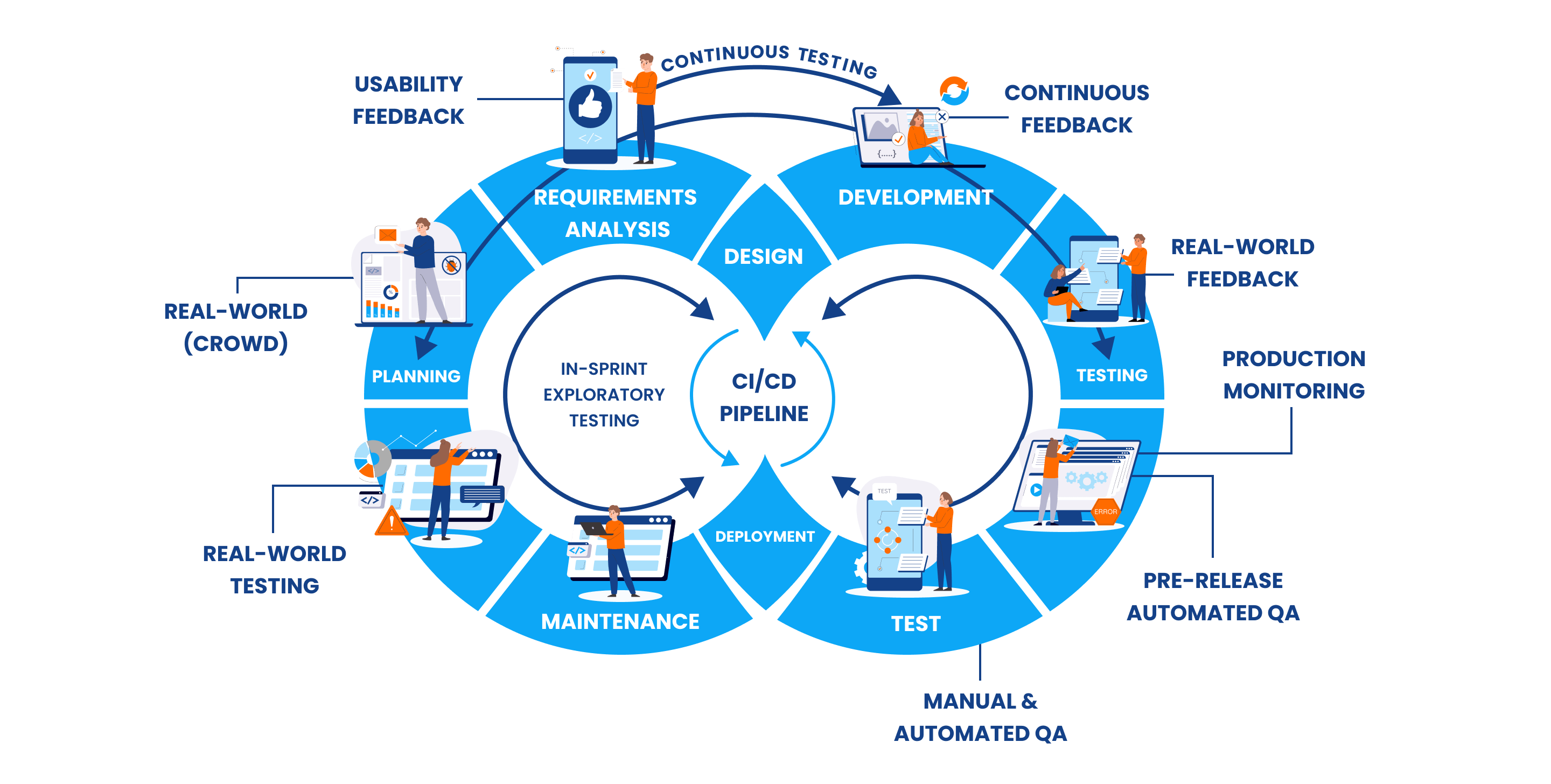
From initial design and prototyping to live production monitoring, Ubertesters embeds real-world crowd testing across every stage of the SDLC. We remove bottlenecks and ensure continuous, real-world validation at the speed of your development cycles.
What This Means for Your Team
- Continuous Feedback Loops: Testers are engaged in-sprint as features are developed, not weeks later.
- Early Critical Bug Discovery: Catch show-stopping issues before they reach customers, protecting revenue and reputation.
- Strengthened Releases: Every deployment, hotfix, and incremental update is validated under real-world conditions, strengthening your confidence with every release.
The result: fewer surprises, smoother releases, happier users, and a stronger product.
Start Continuous Testing Today
How Do You Truly Achieve Continuous Testing During the SDLC?
The Missing Piece: Real Human Insight
Traditional automation validates function (for example, does the button work), but often misses real-world behavior. A feature may pass automated checks yet fail for a user in Japan on a low-end Android device or on a slow public WiFi network.
Crowd testing fills this gap by adding human intelligence, real devices, authentic environments, and diverse user behavior exactly where automation falls short.
How Ubertesters Fits Into Your CI/CD Workflow
With Ubertesters, you can:
- Define: Identify sprint-specific or release-specific human testing needs.
- Launch: Instantly deploy tasks to a globally distributed crowd of real testers.
- Integrate: Receive detailed bug reports, videos, and usability insights directly into your CI/CD tools (e.g., Jira, Jenkins).
- Assure: Maintain software quality from the first sprint through ongoing production updates.
Continuous Testing Services We Provide
Our continuous crowd testing services integrate directly with your DevOps and CI/CD pipelines to ensure constant validation across all SDLC stages. Each service strengthens quality, uncovers issues early, and delivers real-world insight that automation alone cannot provide.
- Exploratory Testing Across Sprints – Uncover unexpected bugs early.
- Usability & UX Validation – Real people providing feedback during design and dev.
- Localization & Global Readiness – Test across languages, cultures, and markets.
- Payment Flow & Transaction Testing – Validate checkout and subscription processes.
- Device & Network Diversity – Ensure performance on different devices and conditions.
- Production Monitoring – Ongoing real-user validation after release to detect regressions early.
- Functional & Regression Testing – Continuous validation of new builds, integrations, and feature updates within your delivery pipeline.
What We Test – Continuous Testing Use Cases

Regression Testing for Major Updates
When launching a large feature or platform change, a targeted crowd rapidly executes high-priority regression cases across hundreds of real devices to reduce post-release defects.
Example: Validating functionality across multiple devices after an iOS 18 update.
Prototype & Early Design Feedback
Crowd testers validate usability and clarity on mockups and prototypes, ensuring user flows are sound before costly development begins.
Example: testing whether users understand a new checkout flow before engineers build it.
In-Sprint Exploratory Testing
Continuous bug discovery while features are being developed, allowing developers to fix defects within the same sprint.
Example: a new search feature is tested daily as it evolves, revealing filtering bugs early.
Pre-Release Validation
A comprehensive test across devices, markets, networks and user scenarios to simulate real-world traffic and conditions before a major launch.
Example: testing your app on 50+ device and OS combinations before App Store release.
Post-Release/Production Monitoring
Rapid validation from real users after hotfixes, patches, or incremental updates to ensure no regressions reach customers.
Example: confirming that a critical payment fix works correctly across all regions.
Continuous Testing Use Cases by Industry
Continuous, real-world testing is essential for any industry with demanding users and rapid release cycles:
Continuous Testing for FinTech & Banking to validate complex payment flows, security, and compliance across diverse devices and regional regulations.
Continuous Testing for E-commerce & Retail to ensure flawless global checkout processes, real-time inventory updates, and mobile usability across peak traffic periods.
Continuous Testing for Travel & Hospitality for real-time validation of booking flows, dynamic pricing updates, personalized offers, and geo-location services under varying international network conditions and time zones. Ensure a seamless user journey from search to check-in, regardless of the user's location or device.
Continuous Testing for Gaming & Entertainment to test stability, in-app purchases, and device performance on the latest iOS/Android/Console releases for a smooth user experience.
Why Crowd Testing for Continuous Testing?
Global Real-World
Coverage:
Test with global users in 150+ countries, thousands of real devices, and real network conditions. No emulators. No simulations. Actual users with actual devices.
Faster Feedback
Loops
Integrate testers directly into your CI/CD cycles, providing critical human feedback in hours, not weeks.
Human Quality Beyond
Automation
Discover critical issues that automation misses, from complex UX breakdowns to nuanced localization defects, edge-case crashes, and payment errors under real-world conditions.
Integrated Confidence
Across the SDLC
Reduce release risk with continuous human validation across every stage of the SDLC, building stronger product trust. Ship faster because you know real users have already tested your code.
Getting Started Process
Achieving continuous, real-world testing with Ubertesters is fast and simple, designed for DevOps and CI/CD teams:
Define
Tell us what you're building, identify your current testing gap (e.g., "In-Sprint Usability" or "Pre-Release Global"), and what success looks like.
Configure
Use our platform to specify target devices, demographics, and test scenario scope. Need iOS users in Italy? Android testers in Brazil? We've got them.
Launch
We instantly deploy the task to the relevant global crowd of professional testers. You push code, we test it, you get results – seamlessly.
Receive
Get actionable, detailed feedback (with videos/logs) injected directly into your development tracking tools to prioritize fixes, and improve with every release. Testing becomes a natural part of your development rhythm.
Continuous Testing FAQ
What is continuous testing in the SDLC?
Continuous testing means validating your software throughout development, not just at the end, by integrating automated and manual testing throughout the SDLC. Instead of testing once before release, you test continuously during design, development, staging, and post-deployment. It’s testing integrated into every phase of the software development lifecycle.
How does crowd testing fit into CI/CD and DevOps workflows?
Crowd testing acts as the necessary human layer. It seamlessly integrates into CI/CD by instantly providing diverse, real-world human validation for builds and release candidates, ensuring the user experience is maintained at the speed of the automated pipeline.
Isn’t continuous testing just automation?
No. Automation is the speed component to handle repetitive functional tests and regressions, but manual (crowd) testing is the quality and user experience component. True Continuous Testing requires both to validate everything from functional stability to real-world usability and complex payment flows. Because automation can’t catch UX issues, cultural problems, real device bugs, or edge cases that only appear in production-like conditions, you need both.
Won't continuous testing slow down our development velocity?
The opposite. Continuous testing speeds you up by catching bugs early when they’re cheap to fix. A bug found during development takes minutes to resolve. The same bug found in production costs you emergency patches, support tickets, and lost customers. Early detection = faster releases.
What's the difference between continuous testing and continuous integration (CI)?
Continuous Integration (CI) automates code building and basic validation. Continuous testing extends CI by providing ongoing human validation throughout the SDLC, testing user experience, real-world scenarios, and complex integrations that automation cannot effectively validate.
At what stages of development can crowd testing be used?
Every stage. Crowd testing can be utilized from the very first stage (validating prototypes/wireframes) through in-sprint development (exploratory testing) and into post-release monitoring (validating hotfixes and incremental updates). If you’re building it, we can test it.
How quickly can Ubertesters integrate into my release cycles?
Most teams integrate within a few short days. We understand your scope and requirements, configure tester criteria, and start testing. No lengthy onboarding. No process overhaul.
Can continuous crowd testing replace my internal QA team?
No – it complements them. Your internal QA focuses on deep product knowledge, test strategy, and automation. Crowd testing adds scale, device diversity, geographic coverage, and fresh perspectives that internal teams can’t provide alone. Think of it as extending your QA team, not replacing it.
What industries benefit most from continuous real-world testing?
Any industry where user experience, global reach, or device diversity matters: fintech, e-commerce, gaming, travel, SaaS, healthcare, media, and logistics. If your users are diverse and distributed, continuous crowd testing is essential.
How much does continuous crowd testing cost?
Pricing depends on your testing scope, frequency, and tester requirements. Unlike maintaining an internal QA team across multiple regions, crowd testing scales with your needs. You pay for testing cycles, not full-time salaries. Most teams find it more cost-effective than hiring testers in every market they serve. Contact us for a customized quote based on your release cadence and coverage needs.
What types of bugs does crowd testing typically catch that automation misses?
Crowd testing catches real-world issues automation can’t detect: UI elements that overlap on specific devices, payment methods that fail in certain regions, confusing navigation flows, culturally inappropriate content, performance issues on older devices or slow networks, and edge cases that only appear with real user behavior. For example, we’ve caught checkout buttons hidden behind keyboards on specific Android models, date pickers that don’t support non-Western calendars, and payment flows that fail only when switching between WiFi and cellular.
Do we need to provide devices, or do testers use their own?
Testers use their own devices, which is exactly the point. You get testing on real devices people actually use: older Android phones, various iOS versions, tablets, different screen sizes, and regional device models you might not even know exist. This real-world device diversity is what catches issues that emulators and lab devices miss.
INTEGRATE CONTINUOUS
CROWD TESTING
Embed Ubertesters into your SDLC and get real-world validation at every step.
Get a personalized consultation on your unique payment testing challenges.