Why Testing Is the Most Important Step After Vibe Coding
+You describe what you need. The AI builds it. In a few hours, you're looking at a working app, a complete feature, or a polished prototype, something that would have taken your team weeks to ship just a couple of years ago.
This is vibe coding: AI-assisted development that turns intent into software at a speed that once seemed impossible. Tools like GitHub Copilot, Cursor, Bolt have made it possible for developers and even non-developers to generate entire applications through natural language conversation. Andrej Karpathy, who coined the term, described it as a mode of programming in which you're "fully giving in to the vibes," with intuition and AI momentum replacing traditional, deliberate engineering. The barrier between idea and implementation has never been lower. A solo founder can build an MVP over a weekend. A product team can have a working prototype in front of users before the sprint planning meeting ends. A non-technical domain expert can turn process knowledge into a functioning tool without writing a single line of code manually.
But here's the question that tends to get glossed over in the excitement: the code works… but does it really work?
The Real Benefits of Vibe Coding
Before diving into what vibe coding gets wrong, it's worth being honest about what it gets spectacularly right because the shift is real, and the productivity gains are not hype.
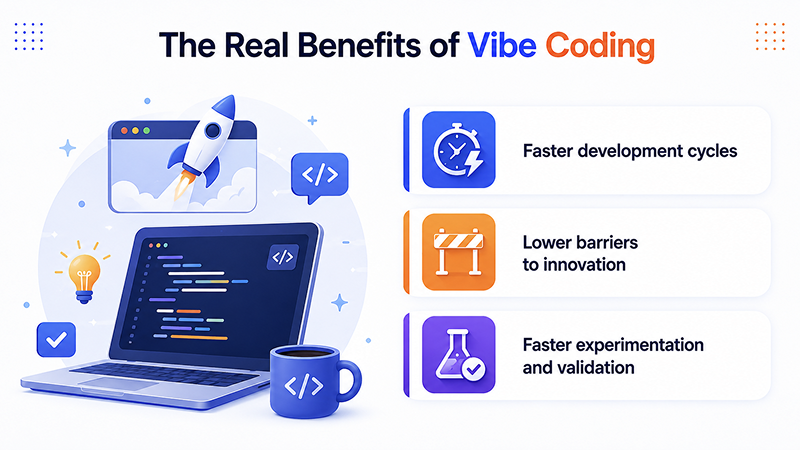
Faster development cycles
What used to require sprints now takes hours. AI code generation compresses timelines in ways that fundamentally change how teams plan, prioritize, and ship. Features that once sat in the backlog for months because of engineering capacity constraints can now be validated in days. That changes what's possible for product teams and what's expected of them.
Lower barriers to innovation
Founders, product managers, and domain experts can build functional prototypes without waiting on engineering bandwidth. The gap between "I have an idea" and "here's a demo" has collapsed. This democratization of building is one of the most significant shifts in the technology industry in years. It puts creative and competitive power in the hands of people who previously had to translate their vision through multiple layers of technical intermediaries.
Faster experimentation and validation
Startups can test ten concepts in the time it used to take to build one. Enterprise teams can validate assumptions before committing to a full development cycle. The cost of being wrong has dropped dramatically, which means more ideas get tried, more hypotheses get tested, and better products emerge from the process. In industries where speed to market is a competitive advantage, vibe coding is a genuine force multiplier.
These aren't minor efficiencies. Vibe coding is reshaping the economics of software development, and that's genuinely exciting.
What Vibe Coding Doesn't Solve
Here's the uncomfortable truth beneath the excitement: AI generates plausible-looking code, not verified code. There's a meaningful and consequential difference between the two.
Language models are trained to produce output that looks correct and reads as coherent. They're optimized for pattern matching and fluency, not for correctness in the context of your specific system. An AI has no deep understanding of your business logic, your edge cases, your regulatory requirements, your data model assumptions, or the particular ways your actual users behave in the real world. It has seen a lot of code; it has not seen your code in the context of your product.
This creates a dangerous illusion. The code compiles. The UI renders. The happy path works perfectly in your local demo. Your quick smoke test passes. And so a false confidence settles in, it runs, therefore it works, and the feature ships.
That confidence has consequences. Real-world examples of vibe-coded bugs slipping into production are already accumulating across the industry:
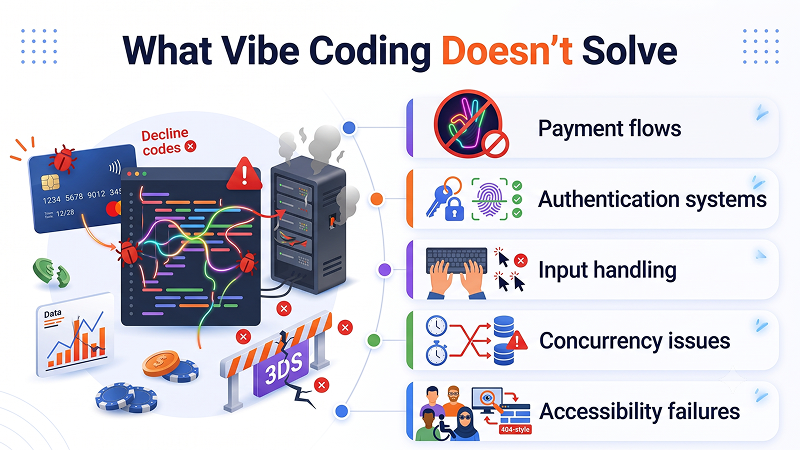
- Payment flows that handle the standard transaction correctly but silently fail on currency edge cases, retry logic after timeout, or specific regional payment methods
- Authentication systems that pass basic login testing but leak sessions under concurrent request conditions, or fail to properly invalidate tokens on logout
- Input handling that validates correctly for English-language inputs but breaks entirely with non-Latin character sets, right-to-left text, or certain Unicode ranges
- Concurrency issues that don't manifest with a single test user but create race conditions, data corruption, or state inconsistencies under real load
- Accessibility failures that automated checks miss because they require a human to actually navigate the interface with a screen reader or keyboard-only controls
The AI didn't write malicious or careless code; it wrote code that satisfied the requirements as stated, without understanding the unstated ones. That gap between what was asked and what was needed is exactly where production bugs live.
Why Testing Is the Most Important Step
Testing is the bridge between "it works on my machine" and production-ready software. It's the process that converts AI-generated code from promising to trustworthy.
This isn't a new idea; testing has always mattered, but it matters more in the vibe coding era, not less, for a specific reason. When engineers write code themselves, they develop an intuitive understanding of its weak points. They know which functions they weren't confident in. They know where they took a shortcut. They know which edge case they thought about but didn't fully handle. That knowledge informs where they focus their testing energy.
When AI writes the code, that intuition disappears. The code may be elegant, the logic may appear sound, and the implementation may look professional but the developer didn't reason through it the way they would have if they'd built it line by line. The vibe coding workflow optimizes for speed of generation, which means the developer's attention is on prompting and reviewing at a high level, not on deeply understanding every implementation decision the model made. That creates blind spots.
Testing is how you find out what's in those blind spots before your users do.
The main testing layers each serve a distinct purpose in the vibe coding context:
Unit tests verify that individual functions and components behave as expected in isolation, catching logic errors before they compound into larger failures. With AI-generated code, unit tests are particularly valuable because they force a human to actually think through what each function is supposed to do and verify that the AI's implementation matches that expectation.
Integration tests confirm that different parts of the system work together correctly, that the payment service communicates with the order management system as intended, that the authentication layer properly gates access to protected resources, that data flows between components without being mangled or lost.
End-to-end tests simulate complete user journeys through the application, from first interaction to final outcome. These catch the class of bugs that only appear when everything is running together in a realistic environment, including timing issues, state management problems, and cross-component failures.
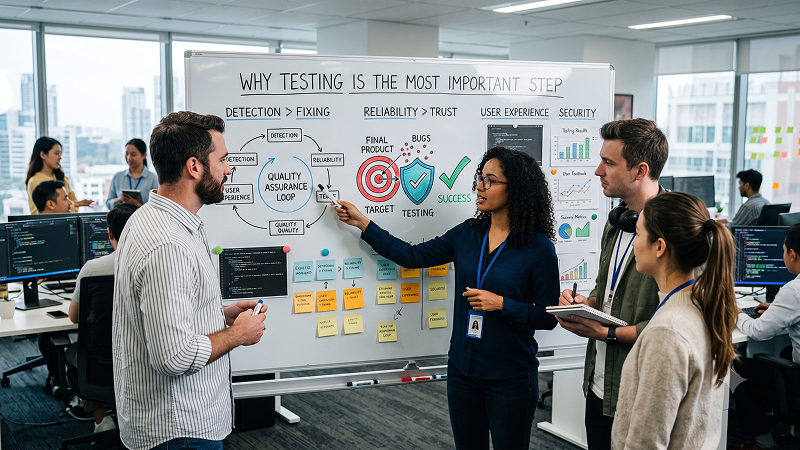
Collectively, rigorous testing validates four dimensions that determine whether software is actually production-ready:
- Functionality: does the software do what it's supposed to do, across all scenarios, not just the happy path?
- Reliability: does it do it consistently, under load, after extended use, and when dependencies behave unexpectedly?
- Security: does it protect user data, resist common attack vectors, and handle authentication and authorization correctly?
- User experience: does it feel right and work intuitively for the people who will actually use it?
AI can write code fast. Only tests prove that code behaves as intended.
Enter Crowd Testing: The Human Layer AI Can't Replace
Automated tests are necessary. They're not sufficient.
Automated testing is, by definition, testing what you thought to test. Your test suite is a reflection of your assumptions about how the software will be used and what might go wrong. If your assumptions are incomplete, and they always are, your automated tests will be incomplete too. They'll pass, and you'll ship, and users will encounter scenarios your tests never imagined.
Crowd testing is the antidote to this. It brings real people, from your actual target market, using real devices, with real networks, in real environments, into your quality process before those users are your customers. It's distributed, human-powered testing that surfaces an entirely different class of problem than any automated suite can reach.
This matters specifically for vibe-coded projects for a fundamental reason: AI doesn't know your users.
Your AI assistant doesn't know that a significant portion of your target audience uses older Android devices on slow, intermittent mobile networks. It doesn't know that your checkout flow silently breaks on iOS Safari when the user has autofill enabled for a different form format. It doesn't know that your localization is technically accurate but reads as unnatural to native speakers, creating hesitation at exactly the wrong moment in the conversion funnel. It doesn't know that your "intuitive" onboarding flow confuses first-time users who don't share the mental model that was baked into its design.
Crowd testers catch what automated tests miss:
- UX friction and confusion that usage data alone won't reveal until you're watching retention numbers decline and trying to understand why
- Device and OS-specific edge cases that only surface on real hardware configurations, not simulated environments
- Cultural and localization issues: translation may be correct, but tone, imagery, or flow may be wrong for a specific market, and that requires native-context testers to catch
- Payment failures by region: different banks, payment processors, and consumer habits create failure patterns that vary significantly across geographies
- Unexpected workflows: the non-linear, exploratory, and sometimes illogical paths that real users take through your application, which your designed user journeys never anticipated
- Performance under real-world conditions: actual network variability, actual hardware constraints, actual battery states, and actual concurrent system load that no lab environment fully replicates
Crowd testing doesn't replace automated testing; it complements it. Automated tests verify that the system does what you told it to do. Crowd testing verifies that what you told it to do is actually what users need and that it works in the messy, unpredictable reality of the real world.
A Practical Testing Workflow After Vibe Coding
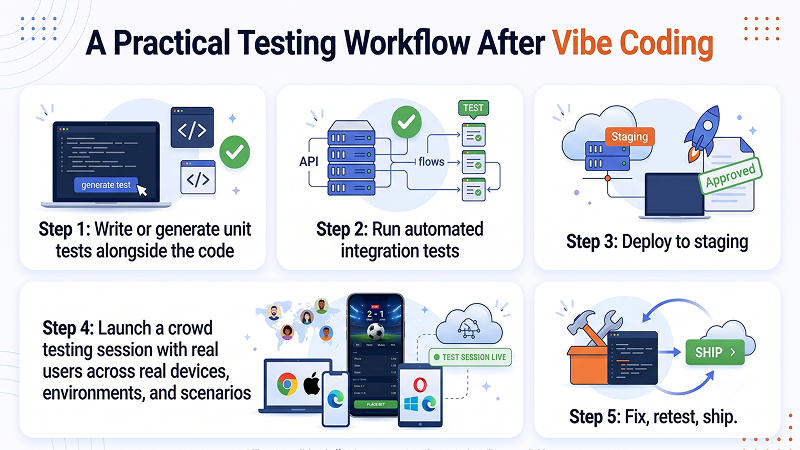
Building testing into your vibe coding process doesn't require a large QA department or a dramatic change to how you work. It requires discipline, sequencing, and the right tools at each stage.
Step 1: Write or generate unit tests alongside the code.
As your AI assistant generates functions and components, prompt it to generate tests in the same pass. Treat test generation as part of the coding conversation, not a separate phase. If you leave it for later, the pressure to ship will always beat the intention to test. Asking the AI to write tests for its own code also surfaces assumptions; sometimes, it will generate a test that reveals the implementation is doing something different from what is expected.
Step 2: Run automated integration tests.
Before anything leaves your local environment, verify that the pieces connect correctly. This is where you catch the class of failures that unit tests miss, the ones that emerge from the interaction between components rather than from any single function. Integration failures caught early cost minutes; caught in production, they cost days and user trust.
Step 3: Deploy to staging.
A staging environment that mirrors your production setup is non-negotiable. Infrastructure differences, environment variables, and third-party service integrations all behave differently in production than in development. Staging is where you find that before users do.
Step 4: Launch a crowd testing session with real users across real devices, environments, and scenarios.
Define clear test scenarios around your critical user journeys, checkout flows, onboarding sequences, and core feature interactions, but give testers latitude to explore beyond the script. The most valuable crowd testing findings often come from the tester who did something you didn't expect and discovered a failure mode you hadn't considered. Ensure your crowd includes diversity across devices, operating systems, locations, and user profiles that represent your actual target audience.
Step 5: Fix, retest, ship.
The findings from crowd testing feed directly back into your development cycle. Fix the issues, run your automated test suite again to confirm you haven't introduced regressions in the fixes, and then ship with genuine confidence, not the false confidence of a local demo that worked.
The Real Cost of Skipping Testing After Vibe Coding
It's tempting to read the workflow above and decide to compress it. Skip the crowd testing session. Deploy straight from staging. Move fast. The cost-benefit calculation on that decision is worse than it appears.
Bugs that reach production don't just create support tickets. They erode user trust, customer trust, and in B2B contexts, enterprise trust that took months of sales cycles to build. A payment flow that fails in the field isn't just a bug report; it's a transaction your user completed with a competitor, and it may be the last interaction they have with your product. Users who encounter failures in critical moments don't file detailed bug reports; they leave, and they sometimes tell others why.
The math on rework is consistently punishing. Bugs cost significantly more to fix after deployment than before it. Fixing a logic error in development costs an hour. Fixing the same error after it's reached production costs that hour plus incident triage, customer communication, hotfix deployment, regression testing, and the ongoing reputational impact of having shipped it.
Vibe coding accelerates creation. It does not accelerate the cost of bugs. Those costs remain exactly what they've always been and may be higher, because the speed of generation makes it easy to ship more surface area before anyone has examined any of it carefully.
A focused crowd testing session can surface issues that would otherwise turn into days of post-launch firefighting. That's the pattern that plays out consistently across teams that treat human-powered testing as a standard release gate, not an optional final step.
The downstream effects on user satisfaction and retention compound in ways that are hard to reverse. Users who encounter failures early in their relationship with a product carry that low-trust posture into every subsequent interaction. Winning back trust after a poor first experience requires far more effort than the testing that would have prevented the failure.
Conclusion
Vibe coding is a genuine superpower. It changes the economics of software development, puts creation in the hands of more people, and dramatically accelerates the pace at which ideas become products. The ability to go from concept to working prototype in hours rather than weeks is not a marginal improvement, it's a fundamental shift in what's possible.
Testing is what makes that superpower responsible.
Without testing, vibe coding is a fast creation with unknown quality. With testing automated at every layer, and human-powered at the final mile it becomes fast creation with validated quality. The speed is preserved. The uncertainty is resolved.
Automated tests catch what you thought to check for. Crowd testing catches what you didn't think to check for. Together, they form the quality layer that separates a demo that impresses from a product that earns lasting trust, software that works correctly, behaves reliably, and delivers an experience worth returning to.
The companies that win in the vibe coding era won't simply be the ones that ship fastest. They'll be the ones that pair AI speed with human-powered quality and consistently deliver software that works as well as it was built quickly. Speed gets you to market. Quality keeps you there.
Don't let your AI-driven innovation fall flat. Partner with Ubertesters to validate your vision before real users find your bugs for you.