The Hidden Cost of Skipping Crowd Testing in Sports Betting Payment Flows

The Moment You Lost a Customer You Never Knew You Had
It is the 87th minute of the Champions League final. A bettor pulls up your app, selects a live wager, and taps deposit. Their local bank returns a cryptic decline. No error surfaces in your QA logs. No alert fires in your monitoring dashboard. The bettor switches to a competitor in under thirty seconds, and they never come back.
This scenario plays out thousands of times across the industry every month, and most operators have no idea it is happening. The transaction never made it far enough to register as a failure on the platform side. But from the bettor's perspective, your product broke at the worst possible moment.
There is a reason the most successful sportsbooks treat payment infrastructure with the same intensity they apply to odds algorithms and live data feeds: in sports betting, payments are the product. A seamless deposit flow is not a feature. It is table stakes. A withdrawal experience that inspires confidence is not a differentiator. It is the baseline expectation every player brings to every session.
The uncomfortable truth is that automated testing and internal QA, however rigorous, cannot replicate the full spectrum of conditions under which real bettors attempt real transactions. Staging environments do not behave like production. Simulated devices do not surface the same edge cases as the phones in your customers' pockets. And test scripts written by engineers do not mirror the impatient, emotionally charged behavior of a bettor trying to get money into their account before kickoff.
This is the blind spot that crowd testing exists to close.
The Anatomy of a Sports Betting Payment Flow
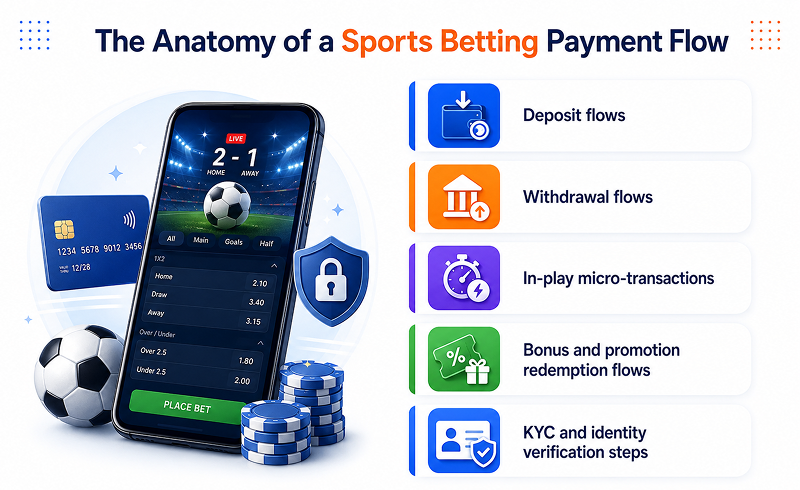
Before examining where things go wrong, it is worth mapping out exactly what a complete payment flow entails, because it is far more complex than a simple deposit or withdrawal.
Deposit flows begin the moment a player selects a payment method and end only when the confirmation is displayed and the balance is updated in real time. Between those two points lie payment method selection, amount entry, authentication challenges (3DS, biometrics, SMS OTP), PSP routing, bank-side approval, webhook receipt, balance reconciliation, and confirmation messaging. Any of these steps can fail, silently or otherwise.
Withdrawal flows carry their own complexity: identity verification checks, fraud scoring, compliance holds, bank-side processing windows, and communication touchpoints that span days rather than seconds. A withdrawal that initiates cleanly but stalls without communication generates support tickets and erodes trust even when no technical fault exists.
In-play micro-transactions operate under entirely different pressure conditions. A live bet placed in a ten-second window during a penalty kick is not a casual transaction. Latency thresholds are measured in milliseconds. Any hesitation in the payment confirmation loop translates directly to lost bets, player frustration, and chargeback risk.
Bonus and promotion redemption flows introduce additional logic layers. Deposit match mechanics, free bet triggers, and wagering requirement tracking are all woven into the payment journey, creating branching conditions that multiply test surface area considerably.
KYC and identity verification steps are increasingly embedded within the payment flow itself. Document upload prompts, liveness checks, and enhanced due diligence screens can appear mid-deposit in certain jurisdictions, interrupting the flow in ways that require careful UX design and equally careful testing.
Each of these components behaves differently depending on geography, device, payment method, and the regulatory framework in scope. A flow that works perfectly for a UK player using a Visa debit card on an iPhone may fail entirely for a Brazilian player using a local e-wallet on a mid-range Android device.
Why Sports Betting Payment Flows Are Uniquely High-Risk
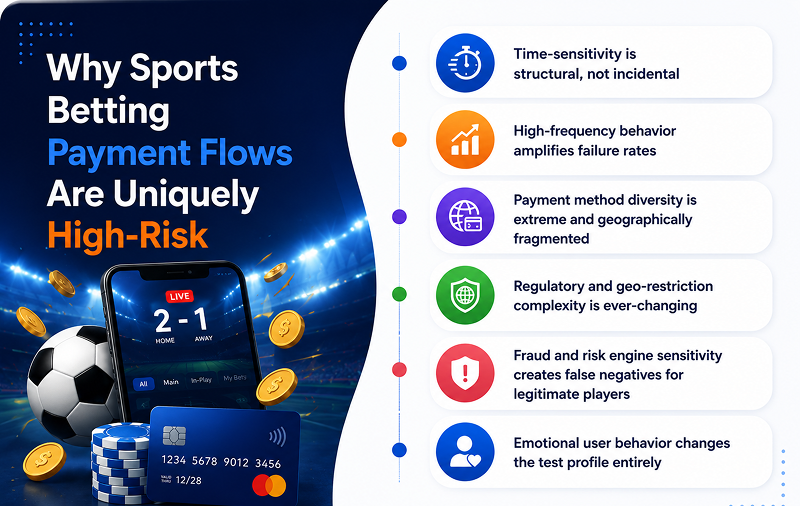
Most digital payment flows carry some level of risk. Sports betting payment flows carry several compounding factors that make them categorically harder to test and more costly when they fail.
Time-sensitivity is structural, not incidental
Unlike retail or subscription payments, sports betting transactions are triggered by external events, such as a match about to start, a window in live play, or a promotion expiring in minutes. The volume of deposit attempts spikes unpredictably and briefly. Players do not wait for technical issues to be resolved. They move on.
High-frequency behavior amplifies failure rates
Active bettors may attempt multiple deposits and withdrawals within a single session. A 2% failure rate that would be tolerable on a monthly subscription platform translates into a significant volume of failed interactions over the course of a busy match day.
Payment method diversity is extreme and geographically fragmented
A single platform operating across five markets may need to support bank cards, local e-wallets, open banking rails, prepaid vouchers, pay-by-mobile solutions, and cryptocurrency channels, each with its own authentication flows, processing windows, and failure modes. What works in Germany does not necessarily work in Nigeria. What works on desktop Chrome may not work on a three-year-old Samsung running Android 10.
Regulatory and geo-restriction complexity is ever-changing
Licensing conditions, responsible gambling payment restrictions, AML obligations, and local banking regulations shift frequently. A payment method that cleared compliance review six months ago may now be subject to additional friction or outright blocking that only surfaces in real-world testing.
Fraud and risk engine sensitivity creates false negatives for legitimate players
Aggressive fraud scoring, while necessary, can and does trigger on legitimate high-value deposits during peak event windows. This is exactly the kind of edge case that a scripted regression test will never surface.
Emotional user behavior changes the test profile entirely
A bettor under pressure behaves differently from a QA engineer working methodically through a test script. They tap buttons faster. They abandon flows mid-way and restart. They retry failed transactions repeatedly. They use older devices on congested mobile networks while watching a match on another screen. This behavior exposes failure modes that controlled testing cannot replicate.
The Hidden Costs of Untested Payment Flows
The direct cost of a failed deposit is obvious: the revenue from that transaction is lost. But the true cost extends well beyond the immediate transaction value, and most of it never shows up in a single line item.
Failed first deposits are disproportionately damaging. Research across the iGaming sector consistently shows that a player who fails on their first deposit attempt is highly unlikely to return. The moment of initial funding is when player confidence is at its most fragile. A failure at this stage does not just cost the deposit, it forfeits the entire projected lifetime value of that player.
Chargebacks and support costs scale with payment friction. Players who experience unclear failure states often attempt the same transaction multiple times before abandoning. Some of those duplicate attempts succeed, generating chargebacks when players notice multiple charges. Others flood customer support with queries that could have been avoided entirely. Both outcomes are expensive.
Negative reviews compound over time. App store reviews referencing payment issues are the most damage-persistent form of negative feedback in the sector. A player who had a frustrating withdrawal experience in January may still be influencing acquisition in October via a review that surfaces in search results.
Regulatory risk is real and growing. Certain jurisdictions now impose formal requirements around payment flow reliability, responsible gambling payment controls, and player communication standards. A failure mode that goes undetected in testing and later surfaces during a regulatory audit carries potential consequences well beyond the technical fix itself.
What Proper Payment Flow Testing Actually Requires
Understanding the requirement is straightforward. Executing against it thoroughly is considerably harder.
Effective payment flow testing for a sports betting platform requires real devices across the full spectrum of what your actual user base owns, not just the latest iPhone and the current flagship Android. It requires geographic coverage that genuinely mirrors your licensed markets, with testers operating local SIM cards, local banking relationships, and local payment method accounts. It requires test participants who behave like bettors, not like engineers, people who are familiar with the product category, comfortable with real-money flows, and capable of recognising when something feels wrong, even if they cannot immediately articulate why.
It requires coverage of every payment method, currency, and authentication variant in scope. It requires structured exploratory testing run alongside scripted regression cases, because the most consequential bugs in production payment flows are rarely the ones you predicted. And it requires feedback loops fast enough to be actionable against release cycles and event calendars which in sports betting move quickly and wait for no one.
Real-World Problems That Crowd Testing Surfaces
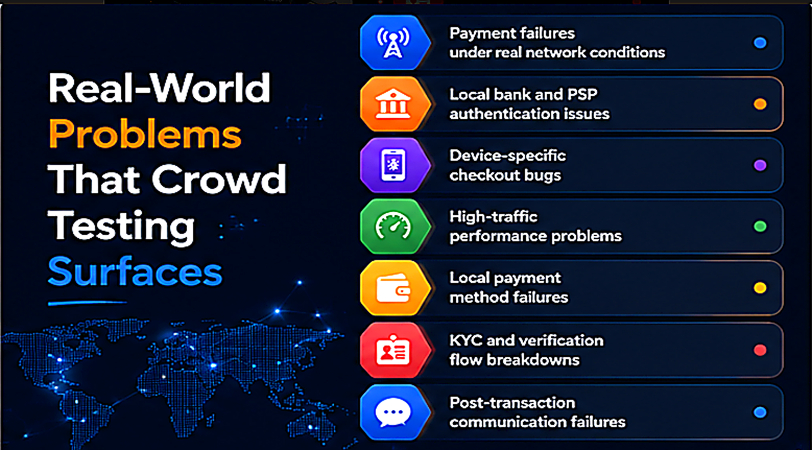
The category of issues that crowd testing uniquely captures follows a consistent pattern across the industry.
Payment failures under real network conditions, such as mobile network congestion, VPN interference, carrier-level filtering, simply do not appear in lab testing. A PSP timeout that occurs reliably on a congested 4G network in a stadium during a major event will never surface in a Wi-Fi-connected test environment.
Local bank and PSP authentication issues are perhaps the single largest category of undetected payment failures. 3DS implementations vary by issuing bank. OTP delivery varies by carrier. Strong Customer Authentication challenges are handled differently across devices, browsers, and banking apps. These issues only become visible when a tester with an actual account at the relevant institution attempts an actual transaction.
Device-specific checkout bugs rendering failures, keyboard overlap on amount entry fields, biometric authentication interruptions, back-navigation that clears payment state require real devices in real hands. Emulators do not reproduce these reliably.
High-traffic performance problems require genuine concurrency. Testing what happens to confirmation latency and session stability when multiple simultaneous deposit attempts hit a PSP during an event window requires real users generating real concurrent load.
Local payment method failures encompass everything from e-wallet SDK integration issues on specific Android versions to open banking redirects that fail on particular browsers to prepaid voucher validation errors that are jurisdiction-specific. These are by definition invisible to any team that lacks local-market testers with local-market accounts.
KYC and verification flow breakdowns often appear only when testers present document types, name formats, or address structures that differ from the internal test data used during development. A verification flow that works perfectly for a tester named John Smith in London may fail silently for a player with a non-Latin name structure in a different market.
Post-transaction communication failures, such as missing confirmation emails, incorrect balance refresh, and failed push notifications, are easy to overlook in lab testing and highly corrosive to player confidence in production.
Why Crowd Testing Is the Right Tool for This Problem
The core value proposition of crowd testing in a payments context is not simply that it involves real people. It is that it combines real people, real devices, real financial institutions, real network conditions, and real behavioral patterns into a single testing layer that no other methodology can replicate.
When a crowd tester in São Paulo uses their actual Nubank account to attempt a deposit on a three-year-old Motorola device over a mobile network, they are not simulating the conditions your Brazilian players experience. They are reproducing them exactly. That distinction is what makes crowd testing uniquely capable of surfacing the failure modes that automated suites and internal teams consistently miss.
The geographic coverage dimension deserves particular emphasis for operators managing multi-market licensing. The payment infrastructure in each market is not just technically different; it is institutionally different. Banking cultures, authentication expectations, fraud sensitivity settings at the issuing bank level, and local regulatory requirements all produce a distinct failure profile for each market. A testing methodology that does not mirror this geographic fragmentation will produce a false picture of payment flow reliability.
The behavioral dimension matters equally. Crowd testers who are active bettors bring product familiarity and emotional authenticity to the test session that internal QA cannot replicate. They notice when a flow feels wrong even if they cannot identify the technical root cause. They explore edge cases organically, attempting to navigate back from a 3DS challenge, retrying a declined transaction, or switching payment methods mid-flow, revealing failure modes invisible to scripted testing.
One of the most operationally valuable characteristics of crowd testing is deployment speed. A structured crowd test focused on payment flows for a specific market or event can be mobilized within 24 to 48 hours, providing a genuine final validation layer before a major event drives peak traffic. This is not a replacement for continuous testing, it is the real-world proof layer that confirms your payment stack is production-ready when it most needs to be.
Where Crowd Testing Fits in the Payment Lifecycle

Crowd testing is not a one-time exercise or a last resort when something goes wrong. The most resilient sportsbook payment operations embed it at multiple points in the product lifecycle.
Before major sporting events and campaign launches, crowd testing provides the final confirmation that payment flows will hold under peak-load behavioral conditions in the specific markets that matter most for that event.
Before PSP or payment method changes, it validates that new integrations behave correctly across the full spectrum of real-world conditions, not just in the controlled environment where the integration was built.
During market expansion, crowd testing in the target market is often the only way to discover local banking quirks, regulatory edge cases, and authentication flows that are invisible from a development environment in a different country.
After releases and payment infrastructure updates, it confirms that nothing regressed in production that was not caught in staging, a category of failure that is distressingly common in complex payment stacks.
As part of continuous monitoring in production, periodic crowd testing in key markets provides an ongoing signal about payment flow reliability that complements automated monitoring and internal QA cycles.
Conclusion: Every Failed Payment Is a Decision Point
Sports betting is a high-trust, high-frequency product category. Players who experience friction in the payment flow do not file support tickets and wait. They leave. And they tell people.
The payment experience is not a support function wrapped around the core product. It is the core product. A bettor's confidence in your platform is built and maintained through every interaction with your deposit and withdrawal flows. A single failure at a high-stakes moment can erase months of positive experience.
Crowd testing is the methodology that closes the gap between what your monitoring tells you and what your players actually experience. It surfaces the failure modes that automation misses, that staging environments cannot reproduce, and that internal teams, however skilled, are structurally unable to encounter. It does this with the speed and geographic specificity that sports betting's event-driven calendar demands.
Skipping it does not make those failure modes disappear. It just means your players find them first.
If you are preparing for a major event launch or expanding into a new market, speak with the Ubertesters payment testing team before you go live.