Payment Testing in Western Europe: How to Test Local APMs Across Major European Markets

A checkout passes every test in staging in Frankfurt. The build ships. Then a shopper in Amsterdam picks iDEAL, lands on her bank's page, approves the payment, and never returns to the store. The order is not created. The money has moved. Support finds out three days later, from an angry email.
Nothing in the test plan was wrong. It was simply written for a market that was too narrow.
Western Europe is often treated as one payments block: one currency in much of the region, one SEPA framework, one regulatory umbrella. On a slide, it looks unified. At the checkout screen, it is anything but. Dutch shoppers expect iDEAL. Belgians reach for Bancontact. Spaniards pay with Bizum. Swedes open Swish. Each method has its own bank connections, its own authentication flow, and its own idea of what a "successful" payment looks like. Conversion is decided by whether your checkout feels native in each of these places, not by how many payment methods your gateway supports on paper.
That is why payment testing in Europe cannot be a single exercise run from one office with a handful of devices. Real-world testing is what separates a checkout that is technically integrated from one that actually converts.
This article walks through the Western European alternative payment methods (APM) landscape, explains why local payment methods are so hard to test, defines what to validate at each stage of the payment journey, and shows how crowd testing closes the gap that lab environments leave open.
The Western European APM Landscape

Before planning a test, you need a map of what people actually use. The headline picture looks like this:
- United Kingdom: Open Banking payments, cards, and digital wallets.
- Germany: PayPal, SEPA transfers and direct debit, and open banking.
- France: Cartes Bancaires co-badged cards, other cards, and wallets.
- Netherlands: iDEAL, with the market moving toward Wero.
- Belgium: Bancontact.
- Spain: Bizum.
- Italy: Bancomat Pay.
- Nordics: MobilePay, Vipps, and Swish.
- Poland: Blik.
The list is short. The complexity behind it is not. Every one of these methods sits on top of different banking protocols, national clearing infrastructure, and local interpretations of Strong Customer Authentication (SCA). The same PSD2 rules produce a fingerprint scan in one country, an SMS code in another, and a push approval inside a banking app in a third.
That is the core friction point: the regulation is shared, but the implementation is not. A checkout that handles one market's flow cleanly tells you very little about the next.
Why Local APMs Are Hard to Test
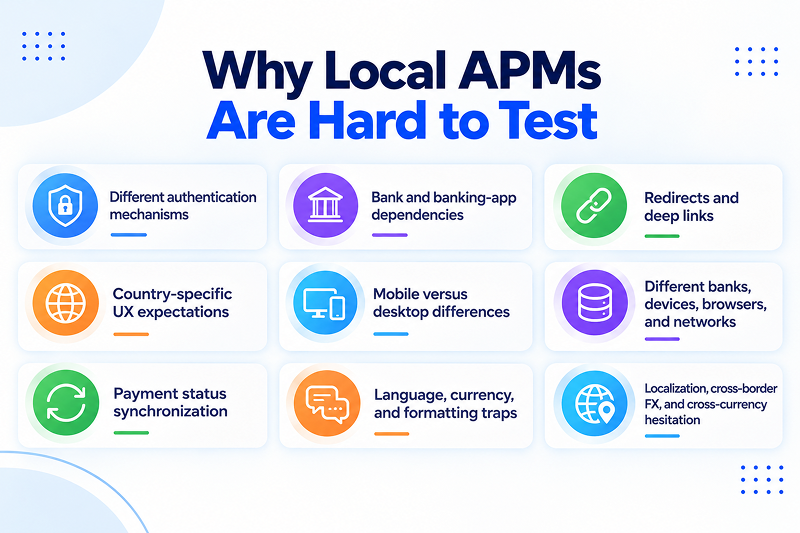
Teams that have tested card payments for years are often surprised by how differently APMs fail. Cards fail loudly: a declined code, an error message. APMs fail quietly, in the handoff between your site, your Payment Service Provider (PSP), and someone else's bank. Here is where the trouble hides.
Different authentication mechanisms
One method relies on a banking app approval, another on a one-time code, another on a biometric prompt. Each has its own timeouts, retry rules, and failure states, and your checkout has to behave correctly in all of them.
Bank and banking-app dependencies
Many local APMs only work if the customer's own bank app is installed, updated, and logged in. You do not control that app. A bank release can change behavior overnight, and you will not get a changelog.
Redirects and deep links
The user leaves your checkout, passes through a PSP page, jumps to a bank or app, and has to be returned to the right place with the right state. Every hop is a chance to lose the session, the cart, or the user.
Country-specific UX expectations
Shoppers have learned what a "normal" payment flow looks like in their country. A bank selector that is unfamiliar, a button label that sounds unnatural, or a logo in the wrong place reads as untrustworthy, and trust drives completion.
Mobile versus desktop differences
A flow that is smooth on desktop with a QR code may require an app-to-app switch on mobile. Some methods are effectively mobile-first, and the desktop experience is an afterthought, or the reverse.
Different banks, devices, browsers, and networks
The number of combinations grows fast. An in-app browser behaves differently from Safari. A bank's page may render badly on an older Android build. A weak mobile connection can break a redirect that works perfectly on office Wi-Fi.
Payment status synchronization
The customer sees "paid." Your order system says "pending." The PSP webhook arrives late, twice, or never. These mismatches are among the most expensive APM bugs because they create duplicate orders, unfulfilled orders, and reconciliation headaches.
Language, currency, and formatting traps
Decimal separators, date formats, address fields, and amount displays differ by country. A price shown as 1.299 can be read as one thousand two hundred ninety-nine or as one and a bit, depending on where you are.
Localization, cross-border FX, and cross-currency hesitation
Shoppers abandon when they are asked to pay in an unfamiliar currency or when exchange rates feel hidden. Localization is a payments problem as much as a translation one.
All of this is hard to cover fully when testing is limited to a small set of devices, accounts, and predefined scenarios. A lab can confirm that the integration works. It cannot confirm that it works for the people who will use it.
APM Testing: What to Validate
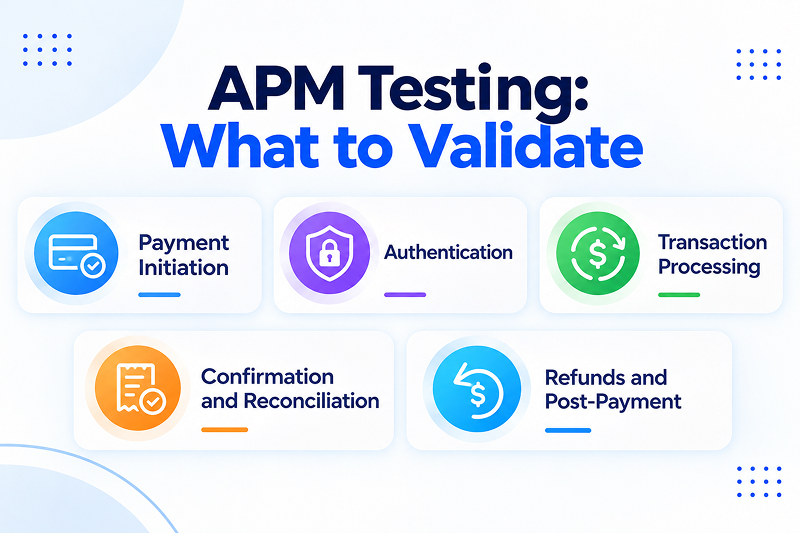
A useful way to organize APM testing is to follow the payment through its lifecycle and ask what could break at each stage.
Payment Initiation
Check that the method appears for the right country, currency, and basket value, and that it is hidden when it should be. Validate payment method ordering and default selection, limits and minimum amounts, saved-method behavior, and form validation for fields such as phone numbers, IBANs, and bank selection.
Authentication
Test each authentication path the method supports: app approval, code entry, biometrics, and fallback options. Cover timeouts, wrong codes, cancelled approvals, and users who switch apps mid-flow. This is where country-specific SCA behavior shows itself.
Transaction Processing
Verify the redirect and return journey end to end. Check what happens when the user closes the tab, presses the back button, loses connectivity, or opens the flow in a second window. Confirm that the session and cart survive the trip.
Confirmation and Reconciliation
The customer-facing confirmation, the order record, the PSP status, and the confirmation email must all agree. Test delayed and duplicate webhooks, and confirm that final statuses match across systems.
Refunds and Post-Payment
Test full and partial refunds, refund timing, and the messaging users see. Check cancellations, chargeback-equivalent processes, and how customer support can trace a transaction.
Across all five stages, testing should cover both successful and unsuccessful scenarios, not only the happy path. Insufficient funds, expired sessions, rejected authentication, and abandoned flows are where real revenue leaks. A payment suite that only proves success has proven very little.
Country-by-Country APM Testing
Although the fundamentals of payment testing remain the same, each market has its own payment methods, authentication flows, and potential points of failure. The following examples highlight the local APMs businesses should consider, the key scenarios to test, and the common issues that can affect the payment journey in each market.
Germany
Local APMs: PayPal, SEPA, open banking. Key test scenarios: PayPal login and approval on desktop and mobile; SEPA mandate creation and confirmation; open banking bank selection and consent; guest checkout versus account checkout. Common risks: Asynchronous SEPA statuses that leave orders in limbo; lost sessions after leaving for PayPal; unclear consent screens in open banking flows.
France
Local APMs: Cartes Bancaires, other cards, and wallets. Key test scenarios: Co-badged card selection, so the customer's preferred network is respected; 3-D Secure challenge and frictionless flows; wallet payments on iOS and Android; French-language error messages. Common risks: Card routing errors on co-badged cards; authentication challenges that time out in in-app browsers; declines that give users no clear next step.
Netherlands
Local APMs: iDEAL, with the transition to Wero. Key test scenarios: Bank selection across the main Dutch banks; redirect to the bank app versus the bank website; return to the merchant after approval, cancellation, and failure; behavior during the iDEAL-to-Wero transition. Common risks: Users who pay but never return to your site; bank-specific redirect quirks; inconsistent status messaging when a payment is pending.
Belgium
Local APMs: Bancontact and mobile payment flows. Key test scenarios: Card-based and app-based Bancontact flows; QR code payments from desktop to phone; Dutch-language and French-language interfaces, since Belgium requires both. Common risks: Language mismatches between your checkout and the bank screens; QR flows that stall between devices; mobile app handoffs that drop the transaction state.
Spain
Local APMs: Bizum. Key test scenarios: Phone-number entry and validation; approval inside the customer's banking app; timeout and rejection handling; behavior when the number is not registered. Common risks: Dependence on a mobile number matching a registered account; approvals that arrive late; poor error messaging when a user is not enrolled.
Italy
Local APMs: Bancomat Pay and bank-based payments. Key test scenarios: App-based authorization; bank transfer flows and their status updates; Italian-language labels and error copy. Common risks: Fragmented bank experiences; slow confirmation that confuses users into paying twice; inconsistent support across banking apps.
Nordics
Local APMs: MobilePay, Vipps, and Swish. Key test scenarios: App-to-app switching on mobile; QR and phone-number flows on desktop; local currency handling for Danish, Norwegian, and Swedish krone; app-not-installed and app-outdated cases. Common risks: Heavy reliance on mobile apps, so any handoff bug hits conversion directly; currency and formatting errors across neighboring countries; very high user expectations of speed.
The UK and Poland deserve the same treatment. Open banking journeys in the UK and the code-based Blik flow in Poland each carry their own authentication patterns and failure modes, and belong in any plan that targets them.
The Real-World APM Testing Challenge
It is tempting to assume that a good sandbox and a few test accounts are enough. They are necessary. They are not sufficient. Lab-based testing tends to miss:
- Local bank differences. Sandboxes simulate banks. They do not reproduce each bank's quirks.
- Real banking apps. Versions, permissions, and update states vary across real users.
- Device-specific issues. Manufacturer skins, OS versions, and browser settings change how redirects and deep links behave.
- Network conditions. Mobile data, roaming, and congested Wi-Fi expose timeouts that office networks hide.
- Regional UX expectations. Only a local can tell you that a label feels wrong or that a step feels suspicious.
- Unexpected redirect behavior. Real flows get interrupted by notifications, app switches, and back-button presses.
- Real user behavior. People do not follow scripts. They hesitate, retry, and abandon.
These are exactly the conditions under which payments fail in production, and exactly the conditions a controlled test environment removes.
How Crowd Testing Extends APM Coverage

Crowd testing puts payment flows in the hands of real users in the markets where those payments are made. Instead of relying only on predefined test scenarios and a limited set of in-house environments, businesses can validate how their payment journeys perform across local devices, payment methods, banking environments, and network conditions.
- Real local testers in target markets across Europe, who understand how payments are supposed to feel in their country.
- Real devices and operating systems Testing on physical iOS and Android devices helps uncover compatibility issues, app-switching problems, and unexpected behavior across different device and OS combinations.
- Local payment methods and banking environments, tested with accounts and instruments that actually exist there to validate the actual customer journey, including authentication, redirects, and returning to checkout.
- Different banks and financial apps, covering the spread of what customers genuinely use.
- Real mobile network and Wi-Fi conditions, including the unreliable ones.
- Country-specific language and UX validation by native speakers.
- Parallel testing across multiple markets: Multiple groups of testers can execute scenarios in different countries at the same time, helping businesses expand market coverage without having to coordinate separate local testing teams.
- Fresh eyes on unfamiliar payment flows, which is how confusing steps and trust gaps get noticed.
The key advantage is broader real-world coverage. Automation remains essential for repeatable checks, while crowd testing adds local environments, real devices, and human exploration to help uncover issues that might otherwise go unnoticed.
How Ubertesters Supports Local APM Testing
1. Global Scale with Local Precision
Ubertesters combines a large global footprint, with 130,000+ vetted testers across 180+ countries, 500+ global payment methods, and 600,000+ real devices, with hyper-local recruitment. This allows businesses to define testing coverage around specific Western European countries, devices, and relevant payment methods rather than treating Western Europe as a single market. Native users in Amsterdam, Berlin, Paris, and Madrid validate regional payment flows on authentic, carrier-connected local devices.
2. Managed Execution and Real Instruments
Testing APMs requires authentic environments. Ubertesters recruits testers who match specific banking relationships, mobile wallets, and device profiles. A dedicated Test Manager handles coordination, environment setup, and quality control, and delivers developer-ready bug reports with screen recordings, console logs, and step-by-step reproduction paths.
3. Continuous Validation and Toolchain Integration
Payment bugs demand rapid iteration. Targeted regression passes run immediately after code fixes to confirm that bank redirects, webhooks, and gateway handoffs work as intended. Testing data flows directly into your existing toolchain, including Jira, TestRail, Slack, or YouTrack, so engineering velocity stays high.
Ubertesters provides an additional layer of real-world validation as payment flows evolve and businesses expand into new markets.
Conclusion: From Payment Support to Payment Confidence
Western Europe is not a single payment market and cannot be tested as one. Each country has its own dominant APMs, its own bank authentication behavior, its own SCA implementation patterns, and its own user expectations at the checkout screen.
The teams that convert well across European markets are not the ones with the broadest PSP integrations. They are the ones who tested those integrations with real users completing real transactions through real bank accounts in each target country.
APM testing should validate the complete customer journey, not just whether a transaction technically succeeds. Crowd testing helps reveal the problems that only become visible when real users complete local payment journeys on real devices and under real conditions.
Expanding payment flows across European markets? Talk to Ubertesters about APM testing with real users in each target country. Request a consultation