MENA Payment Testing: A Practical Guide to Local APMs, Digital Wallets, and Payment Flows
The checkout is green in staging. Every sandbox test passes, and the release ships on Thursday. By Sunday, tickets are arriving from Riyadh and Cairo. A mada payment never confirmed the order. Apple Pay bounced a customer to a bank page and back to an empty cart. An SMS code took eleven minutes to arrive, and the customer bought elsewhere. Nothing in the sandbox was wrong. It just wasn't Riyadh, and it wasn't Cairo.
MENA (Middle East and North Africa) payment testing is the process of validating digital checkout flows, alternative payment methods (APMs), and regional banking integrations using real local devices, networks, and instruments across the Middle East and North Africa. Without it, localized failures like mada routing errors and delayed SMS OTPs destroy conversion rates.
MENA is in the middle of a digital payments boom. High smartphone adoption and national strategies such as Saudi Vision 2030 and UAE Vision 2031 are pushing toward cashless economies, and Cash on Delivery (COD) is steadily losing ground.
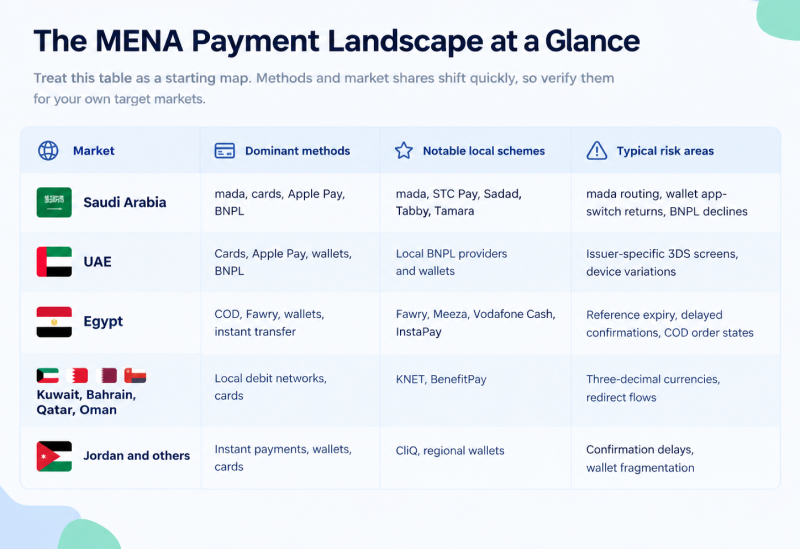
But MENA is not one market. It includes the Middle East and North Africa. Local schemes sit beside global cards, and wallets, BNPL, bank transfers, and COD all compete at checkout. Each country has its own operators, regulators, and habits.
Expanding without localizing and rigorously validating payment flows means checkout drop-offs and rejected transactions. Payment quality here depends on real local instruments, devices, and networks, and crowd testing is how teams get that coverage.
The MENA Payment Landscape at a Glance
Local APMs & Payment Gateways: What to Test and What Breaks
Each family of alternative payment methods fails in its own way.
Local card schemes and debit networks. Stale BIN tables get valid local cards declined or misrouted, scheme-specific authorization behavior differs from global cards, and co-badged cards can land on the wrong network. Test: a local-scheme card on first attempt on iOS and Android, co-badged routing, readable decline messages, and saved-card flows.
Bank transfers and instant rails. "Instant" describes the money, not your order confirmation. Expect confirmation delays and reconciliation mismatches. Test: order status in the gap between payment and confirmation, a customer who pays and closes the app, reference matching, and overpayment, underpayment, and duplicate transfers.
Bill-payment and voucher methods. Reference codes, expiry windows, and partial or late payments are the pressure points. Test: code generation and copying in Arabic and English layouts, order and stock release at expiry, late payment against an expired order, and partial payments surfaced to support.
Cash on delivery. COD is an order-state machine with money, fraud, and logistics attached. Test: refusal at the door and return, cash collected but system not updated (and the reverse), eligibility rules by city and basket value, and the refund path.
Digital Wallets and BNPL
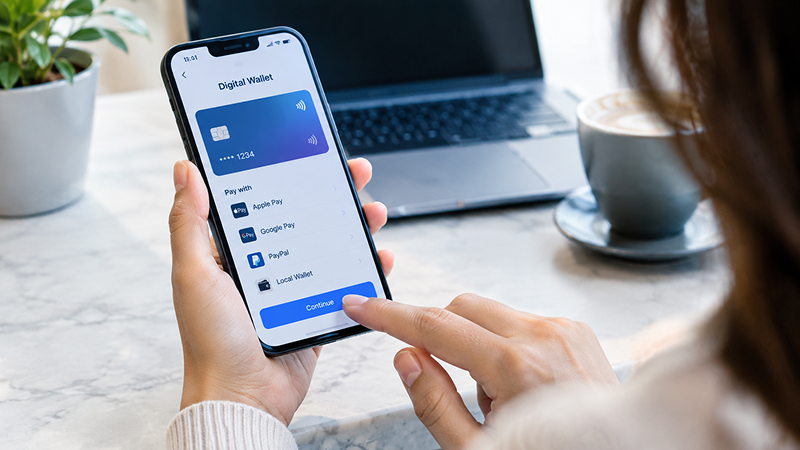
Wallets. Apple Pay, STC Pay, and regional wallets depend on the device, the OS version, and the wallet app itself. The fragile moment is the app-switch: your checkout hands the customer over and expects them back on the confirmation page, not an empty cart.
BNPL. Tabby, Tamara, and similar providers add a decision layer. Test eligibility declines, limits that change mid-checkout, and refunds and cancellations that must match the installment schedule. A decline should let the customer switch method without losing the cart.
Common failure points:
- Abandoned redirects that leave pending orders blocking stock or triggering false success
- Deep-link failures, especially across browsers and in-app webviews
- Duplicate charges on retry when idempotency is missing
Payment Flows, End to End
Authorization to chargeback
Test the full chain, including unhappy paths: late capture, void after partial capture, a partial refund followed by a full one, and chargeback status in the back office. Amounts and currencies should match at every step.
3DS and OTP
Issuers show different challenge screens and timeouts, and the code depends on an SMS actually arriving. See our guide to 3DS payment testing.
Webhooks and callbacks
Providers notify late, twice, or out of order, and "failed" can arrive after "succeeded." Test delayed, duplicated, and reordered callbacks deliberately, and make sure your system is idempotent.
Recurring and subscription payments
Where tokenization support is limited, test rejected stored credentials, failed renewals, and re-authentication prompts.
Region-Specific Edge Cases Most Teams Miss
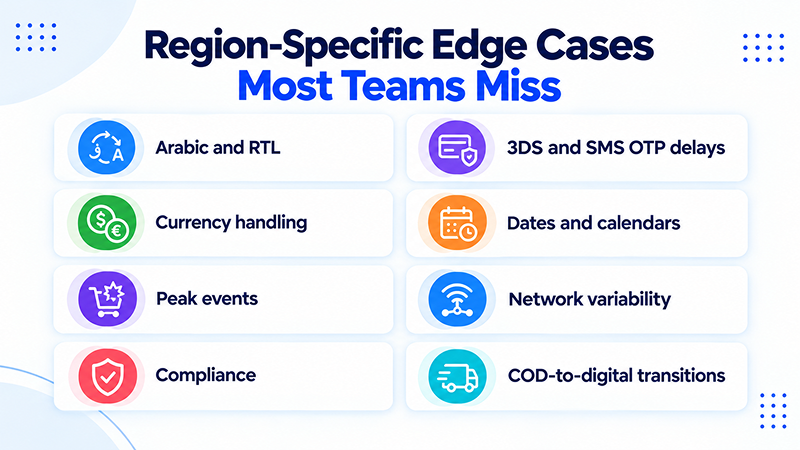
These are the bugs that only appear in-market, where generic test plans fall short.
- Arabic and RTL. Scrambled card and expiry fields, mixed-direction error messages, mirrored arrows pointing the wrong way, and Arabic-Indic numerals (٠١٢٣٤٥٦٧٨٩) rejected by validation that expects Western digits in card and OTP fields.
- 3DS and SMS OTP delays. Operators such as STC, Mobily, Etisalat, and Vodafone Egypt deliver codes at different speeds, or not at all. Test thirty seconds, three minutes, and never: resend option, graceful timeout, late-code handling.
- Currency handling. KWD, BHD, and OMR use three decimals, as does JOD. Two-decimal assumptions break rounding, gateway values, and reconciliation. Check display versus settlement currency too.
- Dates and calendars. Hijri dates can appear on receipts and statements. Test formats and date-dependent logic such as promo windows and renewals.
- Peak events. Ramadan, Eid, and White Friday bring odd-hour traffic spikes and stacked promotions. Test coupon combinations, inventory under load, and provider limits before the peak.
- Network variability. A redirect that loads on office Wi-Fi can time out on a congested mobile network. See our regional testing content (link to regional/network testing article).
- Compliance. PCI DSS and local regulator requirements differ by country. This is a high-level pointer, not legal advice: confirm with your compliance team and provider.
- COD-to-digital transitions. Pay-on-delivery links, QR codes, and courier terminals mix physical timing with digital confirmation. Test cash-to-digital switches at the door and links opened on another device.
The Benefits of Crowd Testing for MENA Payments
Crowd testing gives payment teams real testers in the markets they need to validate, using real devices, networks, payment environments, and local behavior.
- Real-world coverage: real devices, carriers, instruments, and conditions, not simulations.
- Local payment method validation: where real instruments are appropriate and authorized, testers run realistic journeys, not only sandbox responses.
- Broader device and OS coverage: manufacturer, browser, and wallet-version combinations a small lab misses.
- Local expertise: testers know how people pay and what "normal" looks like.
- Speed: parallel testing across countries and methods.
- Scalability and flexibility: scale up for a launch or a Ramadan peak, then down, without permanent local teams.
- Cost efficiency: no device labs or local accounts to maintain.
- Fewer post-launch failures: issues caught before they cost conversion and trust.
- Wider bug discovery: diverse testers find more edge cases.
How Ubertesters Supports MENA Payment Testing
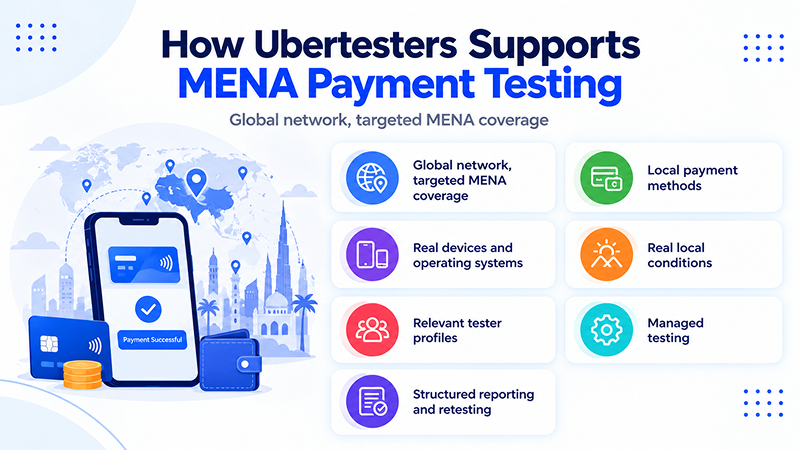
MENA is not one standardized payment environment, so testing must target the markets, methods, devices, and conditions you support.
Global network, targeted MENA coverage
130K vetted testers, 180+ countries, and around 600,000 real devices let us recruit in specific MENA markets instead of treating MENA as one region.
Local payment methods
Where supported and appropriate, testers use the cards, wallets, and APMs of the target market, in the environment where customers use them.
Real devices and operating systems
Real iOS and Android devices, across OS and app versions.
Real local conditions
Testing from the relevant countries, on local networks and real connectivity.
Relevant tester profiles
Recruitment by country, device, payment method, and other required traits.
Managed testing
A dedicated Project Manager coordinates recruitment, execution, issue reporting, and communication.
Structured reporting and retesting
Issues are documented with evidence and environment details, and scenarios are retested after fixes.
Global scale with local, targeted coverage lets you validate MENA payment flows in the environments your customers actually use.
Conclusion
MENA (Middle East and North Africa) is not a market you can test from the outside. The payment methods, devices, language requirements, operator behavior, and regulatory flows that decide success here require real users, in real markets, with real accounts, on real devices.
Teams that get this right before launch treat MENA payment testing as a distinct discipline, not a localization checklist added to a standard payment QA plan.
As MENA's digital payment market keeps growing and national fintech strategies accelerate adoption, the window to earn local trust is set by how well your product works from day one.
Ready to validate your MENA payment integrations with real local testers, local cards, and real devices? Talk to an Ubertesters payment QA specialist today or explore our dedicated Payment Testing Services page.