Launching Payments in Asia: Why Integrations Fail and the Testing Checklist You Need
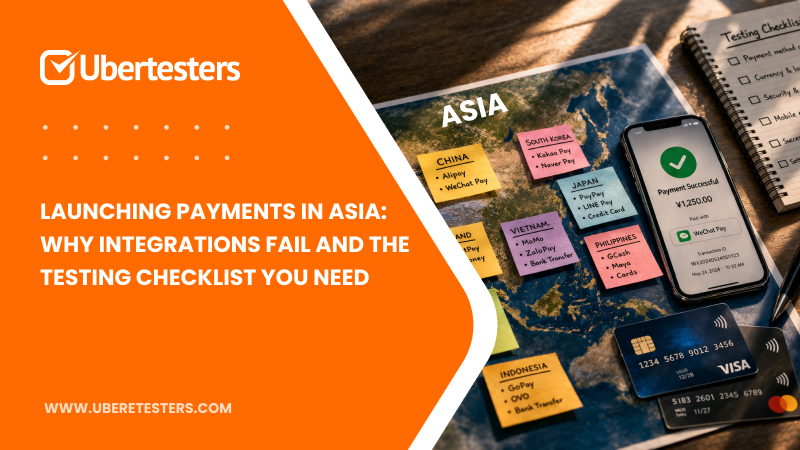
When Payments Work in Europe but Fail in Asia
Southeast Asia and East Asia are among the fastest-growing digital commerce regions on the planet. With hundreds of millions of new internet users, surging smartphone penetration, and rapidly expanding middle classes, the revenue opportunity is enormous. Yet for many companies, the excitement of entering these markets turns into frustration shortly after launch.
The scenario is familiar: your payment integration passes staging tests, clears QA review, and everything looks green. You go live in Thailand, Indonesia, or Vietnam, and within days, the support tickets start arriving. Failed transactions. Wallet authorization errors. Mysterious bank declines. Users abandoning checkout.
The problem isn't your integration. It's that your integration was never truly tested in the conditions where it actually has to work.
Successful market entry in Asia doesn't come down to code quality alone. It comes down to validating local user behavior, local banking infrastructure, and local payment ecosystems with real users, real devices, and real banks. Until you do that, you're flying blind.
Why Asia Is One of the Most Complex Payment Regions

Asia is not a single market. It is a collection of deeply distinct digital ecosystems, each with its own dominant payment methods, regulatory requirements, and user expectations. China, India, Indonesia, Japan, the Philippines, Thailand, and Vietnam all operate under different frameworks, and what works in one country may be completely irrelevant in another.
Unlike Europe, where card payments and a handful of pan-regional standards like SEPA have created a degree of uniformity, Asia's payment landscape is overwhelmingly local. Each market has its own dominant platform:
- China: Alipay, WeChat Pay
- India: UPI, Paytm, Razorpay
- Indonesia: GoPay, OVO, Dana, QRIS
- Philippines: GCash, Maya
- Japan: Konbini (convenience store payments), PayPay
Beyond the payment methods themselves, authentication flows, session behaviors, and user habits vary significantly. Payment flows may require QR code scans, deep app redirects, biometric verification, or real-time bank authorization, none of which behave the same across devices, carriers, or banking institutions.
Asia is also overwhelmingly mobile-first. Between 70% and 90% of transactions in many markets happen on smartphones, often on mid-range Android devices running older OS versions with variable memory, processing speed, and network connectivity.
The result: an integration that is technically sound can still fail when real users in real environments attempt to use it. There is no "standard" integration that works across the region.
Why Payment Integrations Fail in Asia
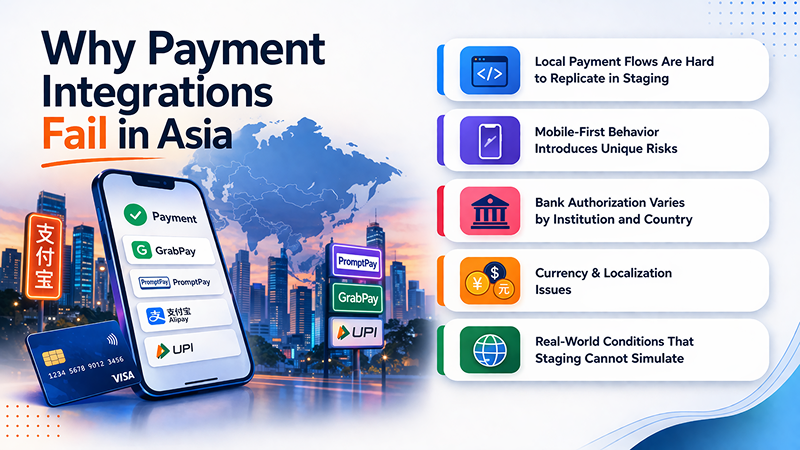
Even carefully built integrations encounter failures in Asian markets. The root causes fall into several categories:
Local Payment Flows Are Hard to Replicate in Staging
Many Asian payment methods involve multi-step flows that go well beyond entering a card number. UPI in India requires app-to-app handoffs. PromptPay in Thailand relies on QR-based flows tied to national ID numbers. Konbini in Japan involves generating a payment code and completing the transaction at a physical convenience store. These flows are notoriously difficult to fully simulate in sandbox environments, and gaps in simulation mean gaps in your testing coverage.
Mobile-First Behavior Introduces Unique Risks
When 80% of your users are on mobile, small technical gaps become large failure points. App-switching during payment flows can break sessions. Redirects to banking apps may not return cleanly. Timeouts that are acceptable on desktops become frustrating dead-ends on slower mobile connections. These issues rarely surface in desktop-centric QA environments.
Bank Authorization Varies by Institution and Country
Banks across Asia apply their own fraud detection rules, transaction limits, and authentication requirements. Some block foreign merchants by default. Others require additional verification steps for first-time transactions. A payment that succeeds with one issuing bank may be declined by another, and sandbox environments cannot replicate the real-world behavior of actual banks.
Currency & Localization Issues
Currency and localization issues add another layer of failure risk that is easy to overlook. Payments can break due to incorrect currency handling, misapplied settlement rules, or exchange rate errors that only surface under real transaction conditions. A price displayed in Thai Baht that silently settles in USD at the wrong rate, or a checkout total rounded incorrectly for a market that expects a different decimal convention, creates both failed payments and user confusion that is difficult to diagnose after the fact.
Real-World Conditions That Staging Cannot Simulate
Real-world conditions in Asian markets are structurally impossible to replicate in a controlled test environment. Network instability is a constant factor, not just slow speeds, but genuine intermittency that affects whether a payment session survives long enough to complete. The "last mile" problem is particularly acute: a global payment gateway may perform perfectly in staging, but technical timeouts between that gateway and a local bank in Vietnam or Indonesia only appear under real routing conditions. Layered on top of this are device-specific issues, memory constraints, background app behavior, and OS-level interruptions, as well as the simple reality that users routinely interrupt payment flows. An incoming call, a lock screen timeout, or a momentary loss of signal mid-transaction can silently break a session in ways that no sandbox environment will ever replicate.
The Hidden Cost of Payment Failures
Payment failures in Asian markets rarely announce themselves clearly. They don't show up as a dramatic spike in your error logs. Instead, they manifest as silent revenue loss:
- Checkout abandonment with no explanation
- Failed deposits that users don't bother to retry
- Subscription cancellations attributed to "payment issues."
- A surge in customer support tickets that only hints at the underlying problem
- Erosion of user trust that's difficult to rebuild once established
By the time the data makes its way into your analytics dashboard, real users have already had a broken experience. In competitive markets where alternatives are one tap away, first impressions with payment reliability are difficult to recover from.
How Crowdtesting Helps Validate Payments in Asia
Automated testing and internal QA teams are essential parts of any development process, but they have a structural limitation when it comes to Asian payment validation. They can verify that your integration is technically correct; they cannot verify that it actually works for real people in real places. The gap between those two things is where most Asian market launches run into trouble.
The core problem is structural. Automated tests and internal QA teams lack the four things that actually matter for real-world payment testing:
Real local devices (not emulators). Emulators don't replicate the hardware constraints of a Xiaomi Redmi or a mid-range Samsung Galaxy A-series, the devices that dominate Southeast Asian markets. Payment UI rendering, app redirect handling, and session memory management all behave differently on real consumer hardware, and failures on these devices simply won't appear in an emulator.
Real local SIM cards. Carrier behavior directly affects redirect speeds, OTP delivery for 3DS verification, and network routing. A tester using a local Telkomsel SIM in Indonesia or a True Move SIM in Thailand will expose carrier-specific failure points that a Wi-Fi-connected internal tester never encounters.
Real local bank-issued cards and wallets. Sandbox environments simulate payment processors; they don't simulate the fraud logic, transaction limits, and authorization behavior of actual issuing banks. A BCA card in Indonesia or a Kasikorn Bank card in Thailand each carry their own approval rules and foreign merchant policies. The only way to know whether your integration works with these banks is to test with their actual cards.
Real local network conditions. A broadband-connected test environment bears no resemblance to a 3G connection in rural Indonesia or a congested 4G network during peak hours in Manila. Network latency and intermittent connectivity affect whether payment sessions survive long enough to complete, and these are everyday conditions for a significant portion of your users.
Crowdtesting solves this by distributing testing across real users embedded in specific countries and markets. They use the phones they personally own, the SIM cards in those phones, the bank accounts they actually hold, and the network connections in their homes. They also behave like real users switching apps, receiving calls mid-flow, retrying failed payments, introducing exactly the scenarios that scripted tests never account for.
What Crowdtesting Can Detect
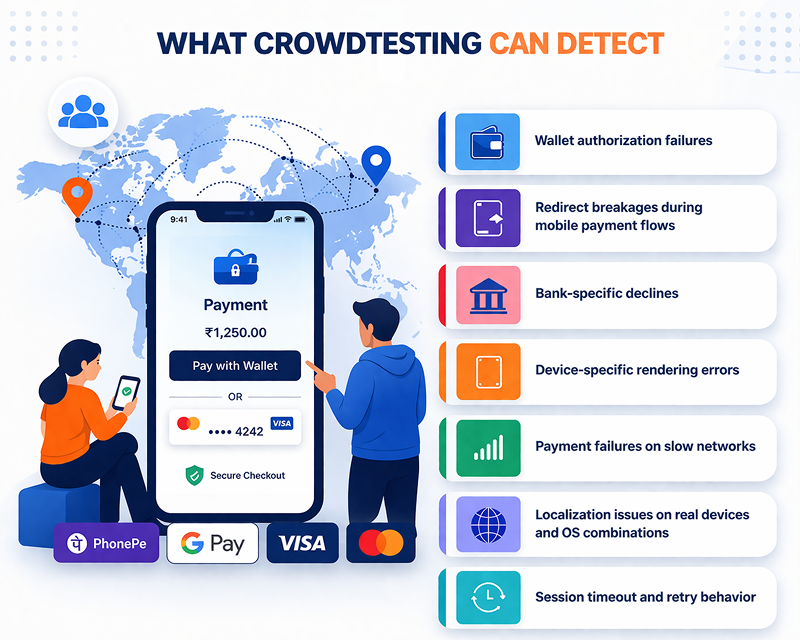
Wallet authorization failures. GoPay, GCash, Dana, and PayPay each have their own authorization flows, and failures often occur at the handoff between your platform and the wallet provider. Real wallet accounts on real devices surface these failures in ways no mock environment can replicate.
Redirect breakages during mobile payment flows. App-switching from your app to a banking app and back is a common failure point on Android devices with aggressive memory management. Real devices under real memory pressure expose redirect failures that emulators never trigger.
Bank-specific declines. A transaction that clears with one bank may be blocked by another applying different fraud heuristics. Crowdtesters across multiple banks in the same market reveal which institutions are problematic before real customers experience it at scale.
Device-specific rendering errors. Payment UI that looks correct in your design tool may truncate or misalign on a 5.5-inch screen with non-standard display scaling. These issues are invisible in emulators and only surface on the actual devices your users carry.
Payment failures on slow networks. Timeout thresholds that work on broadband frequently fail on 3G. Crowdtesters in lower-connectivity areas expose exactly where your retry logic and session persistence break down under real latency.
Localization issues on real devices and OS combinations. Incorrect currency symbols, malformed date formats, and truncated text in Thai or Vietnamese scripts all manifest differently depending on OS version, locale settings, and installed fonts, and only become visible on actual hardware.
Session timeout and retry behavior. When a network drops mid-transaction, does the session recover cleanly? Does the retry flow work? These scenarios require real network instability to test properly.
The value of crowdtesting is in closing the gap that your existing QA process structurally cannot close - moving the discovery of real-world failures to before launch, when fixing them is fast, cheap, and invisible to your customers.
Payment Testing Checklist Before Launching in Asia
Test Local Payment Methods: Validate each local method end-to-end QR flows, app-based payments, and offline options like Konbini with real users on real accounts.
Validate Real Bank Transactions: Test with multiple local issuing banks. Fraud rules vary by institution what passes with one bank may be blocked by another.
Validate KYC and Onboarding Flows: ID types differ by country. Confirm your flow accepts the correct local documents, handles rejections, and completes verification under real network conditions.
Test Mobile Wallet and App Redirect Flows: Confirm redirects to GoPay, GCash, PayPay, and similar wallets return cleanly. Test on real Android devices where memory management can kill sessions mid-flow.
Validate Payments Across Devices: Test on mid-range Android phones and older iOS models, the devices your users actually carry, not emulators.
Verify Currency and Settlement Handling: Confirm currency symbols, decimal conventions, and rounding rules are correct per market. Validate exchange rate handling under live transaction conditions.
Simulate Real User Scenarios: Test interruptions, retries, and failures. Confirm retry logic works and dropped sessions don't result in duplicate charges.
Validate Refunds and Withdrawal Flows: Test partial refunds, wallet withdrawals, and confirmation notifications in the local language.
Validate 3DS Flows with Real Issuing Banks: Test 3DS2 with actual issuing banks. Confirm OTP delivery via local carriers and fallback behavior on timeout.
Check Localization: Validate UI copy, currency formats, and date conventions in the target language across OS versions.
Test Loading Speeds on Local Networks: Test on 3G and 4G in rural and urban areas. Connectivity gaps in markets like Indonesia or the Philippines can break payment flows entirely.
Validate Timeout and Retry Logic: Test under real network instability. Confirm sessions recover cleanly when a connection drops mid-transaction.
Getting This Right: Complex, but Entirely Solvable
Asia's payment landscape represents one of the most significant growth opportunities in digital commerce. But it is also one of the most unforgiving environments for companies that treat payment testing as a checkbox rather than a genuine validation process.
Local wallets, issuing banks, KYC systems, and mobile infrastructure all behave differently from what companies are used to in Europe or North America. Sandbox testing catches configuration errors; it does not catch the real-world failures that emerge when actual users in Bandung or Chiang Mai try to complete a transaction on a three-year-old Android phone with a regional carrier SIM.
The companies that succeed in Asian markets test properly before launch. They use crowdtesting with real local users, real devices, and real payment methods to close the gap between technical correctness and operational reliability. They find the edge cases before their users do. And they launch with confidence because they've already seen their payment flows work under the conditions that matter.
Getting to that point takes effort. But the cost of a failed launch in support overhead, in user trust, in missed revenue is far higher than the cost of getting it right.
If you're preparing for an Asian market launch and want to pressure-test your payment flows with real testers on the ground, let's talk. We'll help you find the gaps before your users do.