How to Test 3D Secure (3DS) Authentication Without Losing Conversions
3D Secure 2.0 (3DS2) exists to cut fraud and satisfy Strong Customer Authentication (SCA) rules under PSD2. On paper it's a clean trade: a little friction in exchange for a lot of protection. In practice, the friction lands at the most fragile moment of the customer journey, when someone has already chosen a product, entered their card details and is one tap from paying.
That is where things go wrong. The OTP arrives late, or never. The banking app opens and doesn't return to the checkout. The biometric prompt flashes and disappears. The challenge page loops back on itself. The customer isn't a fraudster, just a legitimate buyer who gives up and closes the tab.
Most teams test 3DS by checking whether the authentication response comes back correctly. That proves the integration works. It doesn't prove customers can finish paying. Those are two different questions, and only the second one shows up in your revenue.
This article covers what 3DS testing needs to include, why in-house QA rarely reaches the failures that matter, where conversions leak, and how to build a test plan that combines automation with real-world crowd testing. That way you meet PSD2/SCA requirements without paying for them in abandoned carts.
What Is 3D Secure and What Actually Needs to Be Tested?
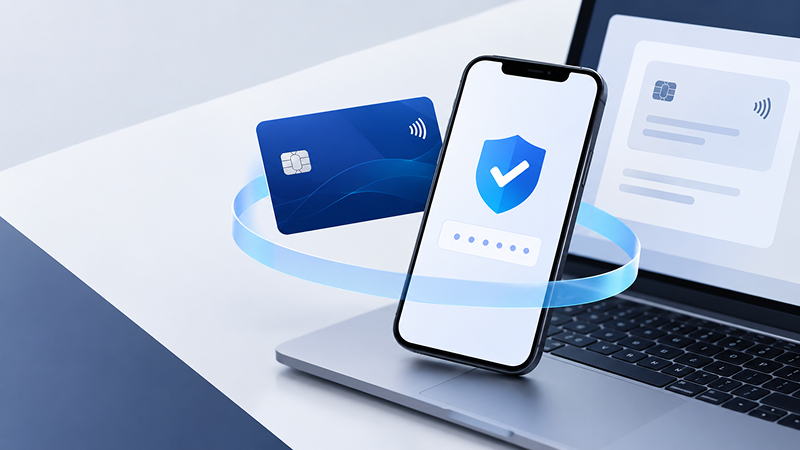
3D Secure is like a digital PIN for online shopping. It asks you to verify your identity (with a code or fingerprint) before your payment goes through. It's that extra "Are you really you?" step that protects your card from fraud.
You don't need a full protocol guide to test 3DS well, but you do need the moving parts straight.
3DS1 vs. 3DS2
The original 3DS1 sent every shopper to a full-page redirect, usually a static password page that looked dated and often failed on mobile. The major card networks phased it out in 2022. 3DS2 (EMV 3DS) replaced it with richer data exchange and in-app, mobile-friendly flows. The merchant sends the issuer far more context about the device and the transaction, so the issuer can make a smarter decision about whether to challenge the buyer at all.
Frictionless vs. challenge flows
When the issuer trusts the transaction based on that data, authentication happens silently in the background, and the shopper never notices. This is the frictionless flow. When the issuer wants more proof, it triggers a challenge: an SMS one-time passcode, a fingerprint or face scan, or an approval tap inside the banking app. Your testing has to cover both, because the split between them is decided by the issuer and it changes from bank to bank.
Four parties, one transaction
The merchant, the payment service provider (PSP), the card network and the issuing bank all take part in each authentication. You control the first, partly control the second, and have almost no visibility into the last two. Many of the failures that cost you conversions live in that blind spot.
Authentication is not authorization
Authentication answers "is this really the cardholder?" Authorization answers "will the bank approve this payment?" A transaction can pass the first and fail the second, and the customer experiences both as "my payment didn't work." Testing only one leaves half the journey unchecked.
3DS and SCA
SCA is the regulatory requirement, mainly under PSD2 in Europe, that many online payments be verified with at least two independent factors. 3DS2 is the mechanism that carries out that requirement. SCA also allows exemptions, such as low-value payments, trusted beneficiaries and low-risk transactions. Whether those exemptions apply correctly is a test target in its own right.
The consequence is that 3DS testing has to follow the complete customer journey: from the moment the shopper hits "Pay," through the authentication step and back to the order confirmation. A green API response at step two says nothing about whether the customer reached step five.
What Makes 3DS So Hard to Test In-House
Testing 3DS in a controlled QA environment can give you confidence that the integration works. The problem is that the real 3DS experience depends on many things that are outside your application.
Every issuer is its own product
The 3DS challenge is often presented by the cardholder's bank, so you are not controlling the entire experience. Different banks can use different authentication screens, verification methods and timeout rules. The same checkout can therefore behave differently depending on which bank issued the card.
Internal coverage is thin
Most internal QA teams can only cover a limited selection of devices, operating systems, browsers and test accounts. Real customers may be using hundreds of different combinations, with cards from many different issuers and in multiple countries. It is difficult to reproduce that level of coverage with a small internal test environment.
Staging can't fake the real thing
Sandboxes and emulators return scripted responses. They can't reproduce a real bank's OTP delivery, the delay added by a mobile carrier, the quirks of a specific banking app version, or the behavior of a phone that hands off between apps under a weak signal. You can pass every sandbox scenario and still ship a checkout that fails for real customers.
Where Conversions Actually Get Lost
Failures in 3DS rarely look like crashes. They look like customers quietly leaving. These are the most common leaks:
- Redirect loops and timeouts on challenge pages. The customer completes the challenge, but the return trip to your checkout stalls, times out, or drops the session. The bank may have already authenticated them, so they're left unsure whether they've been charged.
- OTP delays and failures. Codes arrive after they expire, or don't arrive at all. Delivery depends on the carrier, the network, and the customer's roaming status, and none of that exists in a test environment.
- Broken rendering on specific devices or OS versions. A bank's challenge screen may overflow, hide the submit button, or fail to open the banking app on one OS version while working perfectly on another.
- Misfiring exemption logic. If your regional SCA and exemption handling is wrong, you may force challenges on transactions that qualified to skip them. The customer gets friction for no security benefit, and you pay for it in abandonment.
Each of these is invisible to a test that only checks whether authentication "succeeded."
Why Crowd Testing Fits This Problem Specifically
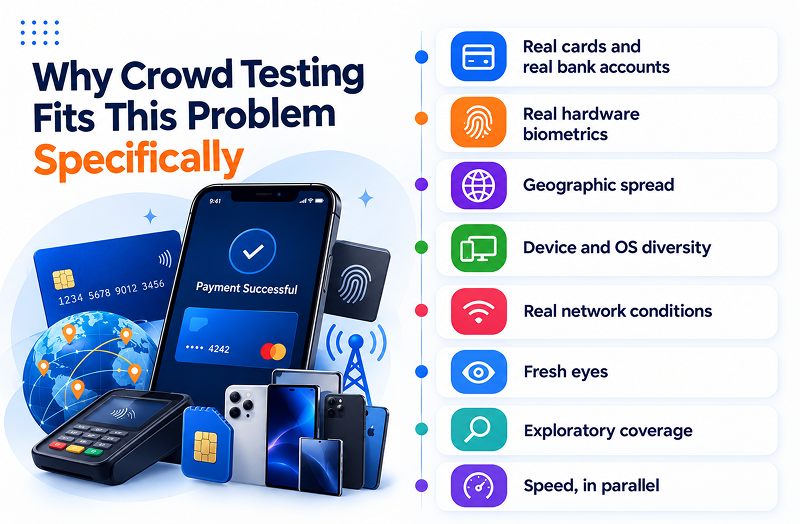
Crowd testing adds real users to the 3DS testing equation. Instead of simulating customers, you put actual people on actual devices, in actual markets, running actual payments. For 3DS, that matches the problem closely, for these reasons:
Real cards and real bank accounts
Issuer-side behavior can only be validated against real issuers. Test cards and sandboxes tell you how your integration behaves, not how a specific bank's authentication logic, risk engine and challenge screens behave. Crowd testers using their own cards are the most direct way to see what your customers will see.
Real hardware biometrics
FaceID and TouchID prompts have to be tested on physical phones. Automation can't press a finger to a sensor, and emulators don't reproduce how biometric prompts behave under varied conditions such as 5G, roaming or public Wi-Fi.
Geographic spread
SCA rules and bank UX differ between the EU and other regions, and between individual countries. Testers distributed across your target markets catch region-specific breakage that a single-country QA team never sees.
Device and OS diversity
A fixed internal device lab covers what you own. A crowd covers what your customers own, including the older handsets and unusual OS versions where challenge screens tend to break.
Real network conditions
Carrier delays, patchy connectivity, and slow SMS delivery produce the OTP and timing failures that automated tests running on stable office networks never trigger.
Fresh eyes
Someone seeing your checkout for the first time reacts the way a customer does. They hesitate at unclear wording, misread a bank prompt, or hit a dead end you'd stopped noticing. That reveals confusion points, not just pass/fail results.
Exploratory coverage
Testers can wander off the script and find the abandonment points scripts miss. They can also complete physical two-factor steps, like reading a code off a second device, which automated UI scripts simply cannot do.
Speed, in parallel
Testers in multiple markets work at the same time, so a regional validation that would take weeks sequentially can be done in days.
Building a Crowd-Tested 3DS Test Plan
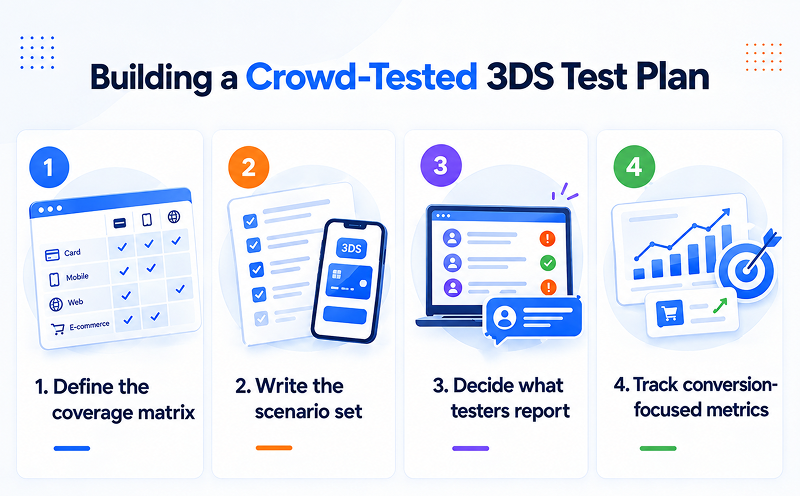
Crowd testing works best when it's aimed. Here is a practical structure.
- Define the coverage matrix. Start from your real user base, not from a generic checklist. List the card networks, issuing banks, regions and devices your customers actually use. Your payment analytics will show which issuers and countries carry the volume and which have the worst authentication failure rates. Weight the matrix toward those.
- Write the scenario set. Give testers clear scenarios to run:
- Frictionless flow, where no challenge should appear
- Challenge flow by method: SMS OTP, biometric and in-app approval
- Failed and retried authentication: wrong code, expired code, canceled challenge
- Exemption flows, such as low-value payments, where a challenge shouldn't appear
- Cross-border transactions, where issuer and merchant regions differ
- Decide what testers report. Ask for more than "worked" or "failed." Useful reports include completion time, each point of friction, exact error messages, and screenshots or recordings of broken states. Also capture the device, OS, bank, network type and location, since these are what make a failure reproducible.
- Track conversion-focused metrics. Measure the numbers that connect testing to revenue:
- Authentication completion rate
- Drop-off by step (challenge shown, challenge started, challenge completed, return to checkout)
- Time to complete authentication
A defect that adds 40 seconds to a challenge may not be a "bug" in a traditional sense, but it costs you customers. Time-to-complete makes that visible.
Combining Crowd Testing with Automation

This isn't a choice between the two. They answer different questions.
Automation tests what you expect to happen. Crowd testing reveals what happens when real people use the payment flow in the real world.
- Automation covers regression on known flows, API-level validation, and regulatory compliance checks. It runs on every release, and it's fast and repeatable.
- Crowd testing covers exploratory, real-condition, real-device testing, which is where the conversion-killing bugs actually hide.
Use automation to make sure the flows you built still work. Use the crowd to find the flows you didn't know to build.
Conclusion: Turn Authentication into Your Competitive Advantage
3D Secure is unavoidable, but losing revenue to broken checkout flows is entirely preventable.
Sandbox environments and automated synthetic API checks can tell you if your code compiles, but only real-world verification will tell you if your customers can actually pay. True payment resilience requires testing with real cards, on real devices, across real issuing banks, in the exact markets where your users live and transact.
Don't let your customers be the ones to find the friction points in your checkout flow. By combining automated pipeline checks with managed real-world crowd testing, you transform 3DS from a necessary compliance hurdle into a seamless, high-converting checkout experience.
Ready to validate your 3DS2 integration with real cards, real bank apps and real devices worldwide? Connect with an Ubertesters payment QA expert today.