How to Conduct Effective Crowd Testing for Your Mobile App Using Ubertesters in 5 Easy Steps
The mobile app market doesn't give second chances. A single crash on a mid-range Android device, a UI element that breaks on one specific screen size, or a checkout flow that stalls on a slow connection is often all it takes to lose a user for good. They uninstall, leave a one-star review, and move on to a competitor's app without a second thought.
This is the gap that catches so many teams off guard: an app can pass every internal QA cycle and still fail the moment it meets real users. Internal testing happens in controlled conditions, on a limited set of devices, from an internal point of view. Real users don't behave that way. They're on hundreds of device and OS combinations, spread across different carriers and regions, using the app in ways your team never scripted for.
Mobile apps are especially exposed to this gap. Android alone spans a dizzying range of OS versions, screen sizes, and manufacturer skins. iOS has its own quirks across device generations. Add regional carriers, spotty networks, and localization requirements, and it becomes clear why lab testing alone can't catch everything.
Crowd testing closes that gap. This guide walks through five steps to run an effective mobile app crowd testing cycle, and shows how Ubertesters makes the process manageable from setup to sign-off.
What Is Crowd Testing (and Why It Matters for Mobile)

Crowd testing means putting your app in front of a distributed pool of real testers, using real devices, on real networks, in real-world conditions. It's the opposite of in-house testing, where a QA team works in a controlled environment with a limited set of devices and an internal, somewhat biased, perspective on how the app should be used.
For mobile apps specifically, crowd testing solves problems that lab testing structurally can't:
- Device and OS coverage. No internal device lab can match the sheer fragmentation of the Android and iOS ecosystems. Crowd testing puts your app on the actual devices your users own.
- Localization and regional behavior. A crowd of testers spread across markets catches language issues, cultural mismatches, and region-specific bugs that a single-market QA team will miss.
- Real network conditions. Testers aren't running your app over office Wi-Fi. They're on 4G in transit, on weak signal, on throttled data plans exactly where your app is most likely to break.
Crowd testing also unlocks speed and scale that in-house teams can't easily replicate. A well-run cycle can run in parallel across 100+ device and environment combinations overnight, without adding full-time headcount.
There's also a growing AI angle worth naming directly. AI-assisted development is letting teams ship code faster than ever, but that speed doesn't translate to fewer usability problems. Code that compiles and passes automated checks can still confuse a real user, break a real workflow, or miss a cultural nuance. Human-driven crowd testing is what verifies the parts of the experience that AI can't judge for itself.
The 5 Steps to Run a Crowd Testing Cycle
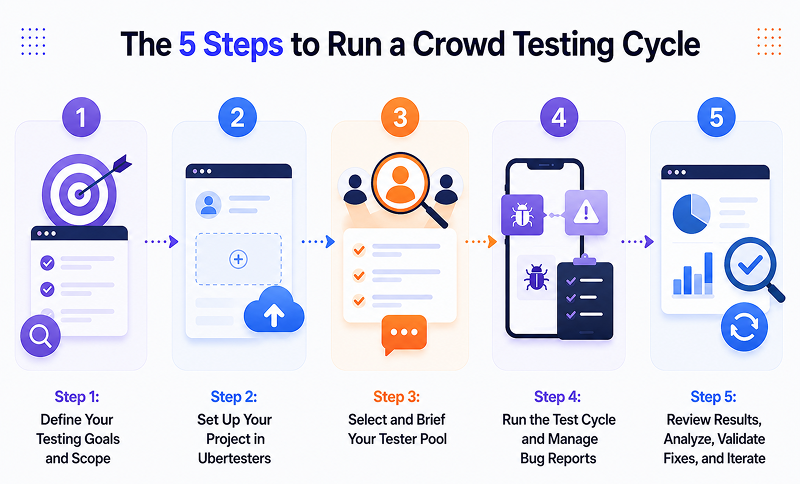
Step 1: Define Your Testing Goals and Scope
Before recruiting a single tester, decide what kind of testing this cycle actually needs. Will testers follow structured test cases and pre-defined scenarios, or is this exploratory, "free-style" testing where they probe the app without a script? Many teams run a mix of both structured cases to cover critical flows, and exploratory testing to surface the unexpected.
Get specific about the type of testing too. Are you validating core functionality, UX and usability, localization, or sensitive flows like payments and KYC? Is this testing a new feature, a redesign, a regression check after a release, an exploratory sanity pass, or a final pre-release cycle?
Finally, choose your target devices, OS versions, and regions based on your actual user base, not a generic "top 20 devices" list. The goal is coverage that matches where your real users are.
Step 2: Set Up Your Project in Ubertesters
Once scope is defined, it's time to set up the project itself. With Ubertesters, this starts with a dedicated Project Manager who acts as your single point of contact throughout the cycle. They translate your business requirements into structured test suites, vet raw tester submissions before they reach your team, eliminate duplicate bug reports, and protect your developers' time from noise.
To get the cycle moving, you'll provide clean documentation: test scenarios or user stories (or an exploratory testing brief if that's the approach), expected behavior, build links, any known bugs to avoid redundant logs, and clear pass/fail or acceptance criteria.
From there, you upload your build as an APK or IPA, or a TestFlight/internal track link, and the project is ready to move into tester selection.
Step 3: Select and Brief Your Tester Pool
A large pool of testers isn't the goal. The right testers are. Testing your app with people who don't match your actual audience produces feedback that looks thorough but doesn't reflect how your real users will experience the product.
Tester selection should filter by device, OS version, geographic location, and language, and where relevant, by user profile: gamers, travelers, financial app users, e-commerce shoppers, whatever matches your app's actual audience.
A good test brief sets testers up to give you useful, actionable reports. It should spell out acceptance criteria and flag the edge cases testers should watch for. Just as important: confirm with all testers that everything is clear before the cycle starts. A misunderstood brief at the start of a cycle wastes everyone’s time and muddies your results.
Step 4: Run the Test Cycle and Manage Bug Reports
With testers briefed, the cycle begins. Testers perform real actions: installing the app, creating accounts, completing workflows, testing features, and exploring scenarios outside the obvious path.
Bugs come in in real time, with screenshots, video, logs, and device or OS metadata attached. Good reporting isn't just "it doesn't work"; it includes clear reproduction steps, comparing ‘expected results’ to ‘actual results’, device/OS/network context, severity, and, where relevant, a video or screen recording showing exactly what happened.
This is where a managed platform earns its keep. Raw tester feedback, on its own, is a pile of unstructured notes. A platform like Ubertesters turns that feedback into something engineering teams can actually triage and act on, with severity tagging, duplicate handling, and a clear handoff process. Integrations with tools like Jira and GitHub mean bugs move straight into your existing dev workflow instead of sitting in a separate system your team has to check manually.
Step 5: Review Results, Analyze, Validate Fixes, and Iterate
Once the cycle wraps, the real work of turning feedback into action begins. Review the test report or dashboard and evaluate findings by severity, frequency, user impact, and business impact. From there, prioritize: critical issues first, then important ones, then minor polish items.
Send prioritized issues to your development team, and don't stop at the handoff; verify that fixes actually resolve the reported behavior. Close the loop by retesting fixes, deciding whether a regression validation cycle is needed, and feeding what you learned back into future sprints.
Crowd testing shouldn't be treated as a one-off event before a single release. Run well, it becomes part of a continuous quality strategy that improves every future release, not just the one in front of you.
Common Mistakes to Avoid
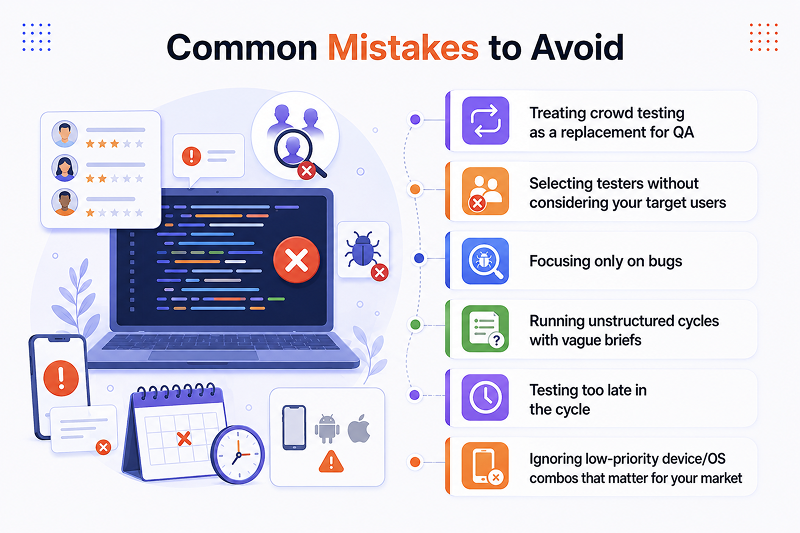
Even well-intentioned crowd testing programs fall short when a few common mistakes creep in:
- Treating crowd testing as a replacement for QA. It works best as one part of a broader QA strategy, alongside automation and internal testing, not instead of them.
- Selecting testers without considering your target users. Testers should match your markets, devices, languages, and user profiles, not just “be available”.
- Focusing only on bugs. Some of the most valuable insights come from usability issues, confusing workflows, and unexpected user behavior, not just crashes or bugs found.
- Running unstructured cycles with vague briefs. Without clear goals, scenarios, and acceptance criteria, results end up too scattered to act on.
- Testing too late in the cycle. Waiting until right before release leaves little room to actually fix what testers find.
- Ignoring low-priority device/OS combos that matter for your market. A device that looks niche globally might be common among your actual users.
Why Ubertesters for This
Successful mobile app crowd testing takes more than finding a pool of testers. It takes the right combination of tester quality, global coverage, testing infrastructure, and a process for turning feedback into something actionable.
That's the model Ubertesters is built around:
- Dedicated project management. A managed model means someone is actively shaping your testing cycle, not just handing you a dashboard.
- Real device coverage and real-world conditions. Testing happens on the actual devices, networks, and regions your users are in, with fast turnaround.
- Structured testing and structured reporting. The output is organized, prioritized, and ready for your dev team, not just a pile of bug tickets.
- Flexible scaling and cost efficiency. Teams can scale testing capacity up or down on demand, without maintaining an in-house global device lab or growing full-time QA headcount to match.
With the right combination of technology, process, and real-world testers, Ubertesters helps companies catch issues earlier, reduce release risk, and ship mobile experiences users can actually trust.
Conclusion
Crowd testing isn't complicated; it's a structured process, and when it's run well, it consistently catches the real-world issues that internal QA and automation can miss.
That's the value of mobile app crowd testing. It puts your application in the hands of real users, on real devices, across real networks, locations, and usage scenarios, before those users become your customers. It uncovers issues that a controlled test environment can never fully reproduce.
The process is straightforward: define what matters, reach the right testers, test in real-world conditions, act on the findings, and validate the fixes. Done consistently, crowd testing becomes more than a pre-launch check. It becomes a practical extension of your QA strategy.
These five steps address some of the biggest challenges in mobile testing: device fragmentation, rapid release cycles, and post-launch failures that can damage app store ratings before your team even knows what went wrong.
With Ubertesters, you can bring this real-world coverage into your testing process without building a global tester network or maintaining your own device lab. Our managed crowd testing approach gives you the people, devices, locations, and testing structure needed to validate your app before your users do.
Ready to reduce release risk and expand your QA coverage? Start a crowd testing cycle with Ubertesters, or talk to our team about what real-world testing could look like for your app.