When a Glitch Costs a Class Period: Why EdTech Needs Real-World Testing

It's 10:42 on a Tuesday morning. A teacher is mid-lesson, screen-sharing a slide deck to thirty second-graders, when the app freezes. The cursor spins. Thirty small faces look up from their tablets, waiting for someone to tell them what happens next. Somewhere else, in a different time zone, a high school senior is ten minutes from submitting a college-application-linked exam when the platform fails to auto-save her answers. She refreshes the page. The progress bar resets to zero. Neither of these moments gets a do-over. The lesson doesn't pause so the app can restart. The exam window doesn't reopen because a server hiccupped.
Since the pandemic pushed classrooms online almost overnight, digital platforms learning management systems, remote proctoring tools, interactive learning apps, virtual classrooms have stopped being a supplement to education. For millions of students, teachers, and corporate learners, they are the classroom, the exam hall, and the training room, all compressed into a browser tab or an app icon. That shift didn't just change how people learn. It changed what "quality" has to mean for the software underneath it.
Most software bugs cost time or money, and both are usually recoverable. Retry the checkout. Refresh the dashboard. Wait for the next deploy. EdTech bugs cost something structurally harder to get back: a fixed, unrecoverable window. A class period. An exam slot. A homework deadline. A live cohort session that only happens once. When that window closes, it's gone for that student, on that day, and there's no patch that un-loses forty minutes of a lecture nobody can attend twice.
Lab testing is good at what it's designed for: catching functional bugs before release, in a controlled environment, on a known set of devices. But delivering a genuinely reliable learning experience means testing under the same messy, unpredictable, and often uncooperative conditions that real students and educators face every single day: patchy school Wi-Fi, five-year-old tablets, a substitute teacher who's never used the platform before. That's where real-world crowd testing earns its place, not as a nice-to-have, but as the missing half of a QA strategy that lab testing alone can't complete.
The Hidden Cost of a Broken Login or Lag
A frozen app or a ten-second lag doesn't sound like much on a bug report. Filed in a ticketing system, it might even get a low-priority label. In a live classroom, it's different math entirely. Multiply thirty students by even ninety seconds of confusion, and a teacher hasn't lost ninety seconds; they've lost the momentum of the entire lesson. The moment when attention was highest is now spent staring at a spinning wheel, and rebuilding that focus takes far longer than the outage itself ever did. Do it two or three times a week, and trust in the platform erodes faster than any single incident would suggest on its own. Teachers start opening backup tabs before class even begins. Students start expecting things to break. That expectation, once it sets in, is very hard to undo.
This is the gap between "the app works" and "the app works for this specific student, on this device, on this network, today." A learning platform can pass every internal QA cycle, hit every acceptance criterion, and still fail the only test that actually matters: does it hold up for a seven-year-old on a school-issued Chromebook with spotty Wi-Fi, or for a working adult squeezing a corporate training module into a lunch break on a phone hotspot in a parking lot? Does it hold up for a college student in a dorm sharing bandwidth with six roommates during finals week?
K-12, higher education, and corporate learning and development all carry different stakes, and it's worth being specific about how. In K-12, the audience often has the least patience and the least technical troubleshooting ability, a young student who hits an error doesn't know to clear a cache or try a different browser, they just raise a hand or give up. In higher education, the stakes shift toward high-pressure, time-boxed moments: proctored exams, application deadlines, timed lab submissions, where a glitch doesn't just interrupt learning, it can affect a grade or a transcript. In corporate L&D, a glitch in a compliance training course might seem like a minor inconvenience, until you consider that the training exists precisely to satisfy a regulatory or legal requirement, and an incomplete record because a module crashed mid-way can become a compliance gap, not just a bad user experience. Different contexts, different consequences, but the same underlying fragility running through all three: software that was never tested under the real conditions its users actually live in.
Why EdTech Bugs Are Different and More Complex
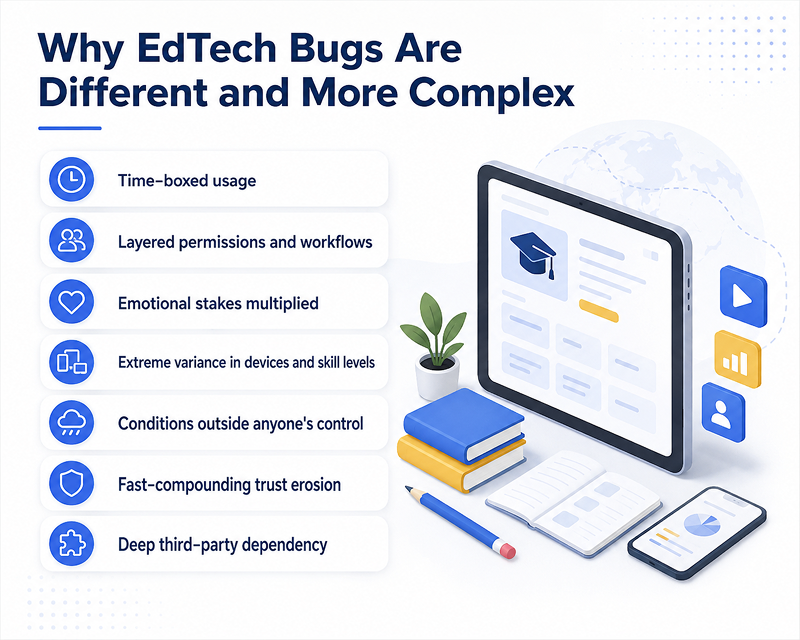
It's tempting to treat this as a generic "bugs are bad" argument. It isn't. EdTech carries a structural fragility that most other software categories don't.
Time-boxed usage
A live class or a scheduled exam has a hard start and end time. A bug that hits during that window can't be patched and retried for the student who experienced it; the moment has already passed.
Layered permissions and workflows
A single platform has to get file uploads, assignment submission, grading logic, and exam integrity right simultaneously, across different permission levels for students, teachers, and administrators. A failure in any one layer can quietly corrupt the others.
Emotional stakes multiplied
One glitch rarely affects just one person. A dropped connection during an exam creates a frustrated student, a disrupted teacher, and often within the hour, a concerned parent asking questions the school wasn't ready to answer.
Extreme variance in devices and skill levels
The same platform might be used by a first-grader tapping unfamiliar icons on a shared tablet and by an adult learner who expects the polish of a consumer SaaS product. Designing and testing for both simultaneously is genuinely hard.
Conditions outside anyone's control
School Wi-Fi congestion, home broadband quality, mobile data, and shared family devices all shape the experience, and none of them are things the platform vendor controls.
Fast-compounding trust erosion
Parents and school administrators decide quickly whether a platform is "reliable enough" to keep using. There's little tolerance for a second bad first impression.
Deep third-party dependency
Google Classroom, Microsoft Teams, Zoom, various LMS platforms, and SSO providers are all stitched into the experience, and each integration point is a place where things can quietly break.
Why Lab Testing Falls Short for EdTech Specifically
None of this is a knock on lab testing; it's essential for catching functional and regression bugs early. But a sandbox environment simply can't replicate school Wi-Fi congestion, a classroom of shared devices, an outdated tablet held together with a cracked screen protector, or a district's content-filtered network.
In-house hardware labs run into a scaling problem, too. EdTech runs on some of the most fragmented device and OS landscapes in software: aging Chromebooks, budget Android tablets, hand-me-down iPads, and no internal lab can economically stock and maintain that range.
Then there's the human factor. Age-diverse users interact with the same UI in completely different ways, and accessibility or usability gaps often only surface with real people navigating a real interface, not with scripted test cases. Add different countries, languages, and accessibility requirements, and the test matrix balloons well past what a QA team can cover alone. And no synthetic load test quite replicates peak-time concurrency the way an entire class logging in at 9:00 a.m. sharp does.
What Crowd Testing Adds: Real Devices, Real Networks, Real Users
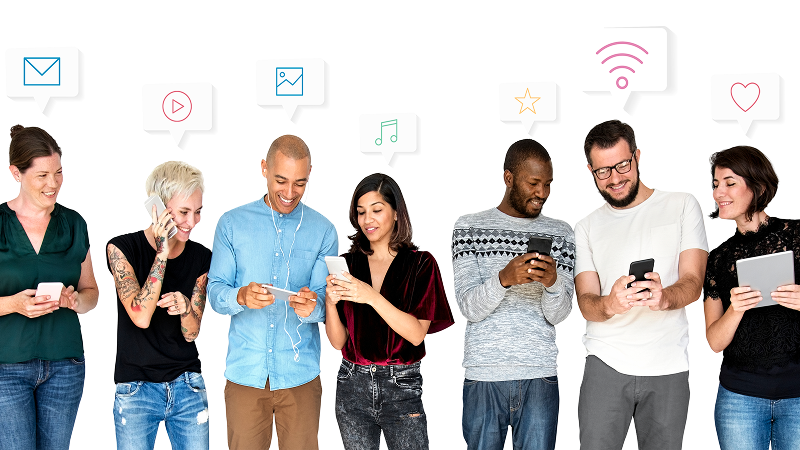
Crowd testing works by distributing test cases and real-life scenarios to a global community of real testers, using their own devices, networks, and locations, instead of relying solely on internal staff and simulated environments. For EdTech platforms, that shift in approach directly closes the gaps lab testing leaves open.
It brings geographic and network diversity, testing across regions, ISPs, and right-to-left languages, and verifying that multi-language support and regional payment gateways for paid courses actually hold up outside a controlled office network. It brings device coverage that matches what schools actually use: Chromebooks, budget Android tablets, and older iPads still common in classrooms years after they'd be considered obsolete elsewhere.
It also brings something automation fundamentally can't: human testers catching UX confusion that a script isn't built to notice, the moment where a button is technically clickable but nobody would guess what it does.
Because crowd testers can be matched by role, the same flow can be validated from every side of the platform at once: one tester moving through it as a student, another as a teacher, a third as a parent. That kind of real multi-role perspective regularly reveals inconsistencies in what each role actually sees or receives, gaps that are invisible if only one persona is ever tested.
Crowd testers can also simulate real exam-day pressure realistically, running through quiz and assessment flows exactly as a real student would: completing timed sections, triggering auto-save, uploading files, and deliberately interrupting their own connection mid-submission to see whether progress survives.
Finally, crowd testing gives EdTech platforms scalability for seasonal and hourly spikes. Dozens of testers can be deployed simultaneously to run localized stress and concurrency testing, the digital equivalent of thousands of students clicking submit on a final exam module within the same sixty seconds.
Real-World Failure Points Crowd Testing Catches
Some of the most damaging EdTech bugs never show up in a lab, because they only exist at the intersection of real devices, real networks, and real human behavior- three variables no sandbox environment can fully recreate at once. Crowd testing is built to find exactly these:
- Login or SSO breaking under a specific district's identity provider configuration. A platform can authenticate flawlessly against a generic test account and still fail the moment it meets a real school district's specific Active Directory or Google Workspace setup, locking out an entire class on the first morning of the semester.
- Video or audio lag and freezes during live or recorded lessons, often triggered not by the platform itself but by the combination of an aging device's processor and a school network straining under dozens of simultaneous video streams.
- Quiz and assessment submission failures under poor or intermittent connectivity, the exact moment a student can least afford a technical problem, and the exact moment lab testing, run on a stable office connection, is least likely to catch one.
- Accessibility gaps: screen reader incompatibility, font scaling that breaks layout instead of simply enlarging text, poor color contrast that lab QA routinely misses because internal testers rarely test with the assistive technology real students depend on.
- A "Join Class" link that works flawlessly from a laptop but fails to open correctly from a phone's default browser, silently routing a student to a blank page instead of the live session they're already late for.
- Localization issues that surface only in genuinely multilingual classrooms: text that overflows its container in German, a right-to-left layout that breaks a quiz's answer order in Arabic, a date format that confuses an assignment deadline in a different region.
- A push notification reminding a student about a live class that arrives after the class has already started, turning a helpful feature into a source of confusion and missed attendance.
- A "resume where you left off" feature that quietly loses a learner's place when switching from Wi-Fi to mobile data mid-commute, forcing a student to rewatch material they already completed or, worse, assume they finished something they didn't.
- Third-party integration failures in embedded video players or regional payment gateways, visible only under real consumer network conditions: a Zoom embed that loads for a tester in Berlin but times out for one in Manila, or a payment gateway that silently declines a legitimate card issued outside its expected region.
Each of these looks small in isolation, the kind of thing that might get triaged as "low severity" in a bug tracker. In aggregate, across a semester and thousands of students, they're the difference between a platform teachers actively recommend to colleagues and one they quietly start working around or replacing.
Building a Hybrid QA Strategy for EdTech Platforms

The strongest approach isn't lab testing or crowd testing; it's both, deployed deliberately for what each does best, rather than treating one as a replacement for the other. Lab testing, backed by automation and internal QA, remains the right tool for core functionality and regression coverage. It's fast, repeatable, cheap to run frequently, and it catches the bugs that shouldn't ship in the first place: broken buttons, failed API calls, logic errors in grading calculations. No platform should skip this layer; it's the foundation everything else builds on.
Crowd testing earns its place at a different point in the cycle: before the moments that matter most. A new semester launch, when thousands of returning and first-time users log in within the same 48-hour window. A major feature rollout, before it reaches every classroom rather than after. An exam period, when the cost of a single unresolved bug is measured in grades and trust rather than support tickets. Run at these moments, crowd testing acts less like a final gate and more like a rehearsal, surfacing exactly the kind of real-world failure a lab environment structurally can't produce.
And ideally, it isn't a one-off event triggered only when something feels risky. The strongest EdTech QA programs tie crowd testing to a recurring cadence that mirrors the academic calendar itself: a testing pass ahead of the back-to-school surge in late summer, another before midterms, another before finals, and a lighter continuous cycle in between to catch drift as new features accumulate. That rhythm means the platform gets stress-tested right before the specific weeks it can least afford to fail, not discovered to be fragile in the middle of them.
Reliability Is the Product
Students and teachers depend on their platforms working, every single day, without a backup plan for when they don't. There's no equivalent of a customer service refund for a lesson that never happened, or an exam a student couldn't finish because a progress bar failed. A failed lesson can't simply be retried without consequences, and no amount of post-incident apology fully restores the forty minutes it cost.
In EdTech, a bug isn't just a bug it's a lost class period, a disrupted teacher, a disengaged student, and often a parent or administrator quietly re-evaluating whether this platform is the right one to keep paying for. A single glitch, repeated often enough, costs more than lost time; it costs user trust, it costs renewal contracts, and in a market where switching platforms between semesters is a real and common decision, it costs the relationship entirely.
Real-world testing across real devices, real networks, and real learners and educators, in the actual conditions they show up in every day, is what keeps a learning platform stable, accessible, and intuitive across the enormous diversity of people who depend on it. It's the difference between a platform that merely passed its test suite and one that's actually ready for the first day of school.
Partner with Ubertesters to put your EdTech platform through real-world crowd testing on real devices, with real users, anywhere in the world. Learn more on our EdTech & Learning testing page