From Booking to Boarding: Crowd Testing for Travel & Mobility Apps

Search. Book. Pay. Get the confirmation email. Check in. Change a flight at the last minute. Board. For a traveler, this is one continuous journey. For the app behind it, it's a chain of features, each one built, deployed, and too often tested in isolation. A single broken link anywhere in that chain doesn't just create a bug ticket. It can cost a booking, strand a traveler mid-trip, or quietly push a customer toward a competitor's app the next time they need to fly, book a room, or grab a ride.
Travel and mobility apps are some of the most complex products in consumer tech. They combine payments, identity verification, location services, real-time third-party integrations, and time-sensitive interactions, often all in the same session. That complexity is exactly why they're so hard to test well. Lab testing can confirm that each feature works on its own. It can't confirm that the whole journey holds up across real devices, real networks, and real locations, which is precisely the environment travelers actually use these apps in.
The Traveler Journey Is Only as Strong as Its Weakest Step

A typical trip touches an app at several distinct stages: discovery and search, booking, payment, itinerary management, and the day-of-travel moments: check-in, boarding pass retrieval, rideshare pickup. Each of these stages puts different technical demands on the product. Search has to be fast and accurate under load. Payment has to be secure and localized to whatever market the traveler is booking from. Day-of-travel features have to be reliable under pressure, because there's no room for a retry when someone is standing at a gate.
That last point is worth sitting with. A bug that looks minor in a lab environment a screen that takes an extra two seconds to load, a sync delay between the app and a backend system becomes a major failure the moment it happens at boarding. Context changes the severity of a bug. Testing environments that don't reflect that context will consistently underestimate the risk.
Why Lab Testing Misses Journey-Wide Failures
Lab QA is built around testing features in isolation, under controlled conditions, on a limited set of devices. That's a reasonable way to catch functional bugs, but it's structurally unable to validate an end-to-end journey the way a real traveler experiences it.
Consider what a lab environment simply cannot reproduce. It can't replicate the thousands of real device and OS combinations travelers actually use, or the effects of roaming, airport Wi-Fi congestion, and mid-journey carrier handoffs. It can't easily account for the fact that travel apps operate across multiple countries, languages, and regulatory environments, different currencies, date and time formats, local payment methods, identity verification requirements, tax rules, and travel regulations, all varying market to market. A pricing or availability bug that only shows up for users booking from a specific country is invisible to a QA team testing from a single location.
Lab testing also misses the human factor. Travelers are frequently in a heightened state rushing to catch a flight, standing in a security line, dealing with a delay, trying to rebook at the last minute on a spotty connection. These conditions produce behaviors and edge cases that scripted test cases rarely anticipate, because scripted tests assume a calm, deliberate user on a stable connection. Add to that peak-load scenarios like holiday booking surges or mass check-in windows ahead of a big travel day, and you have load conditions that are genuinely difficult to simulate synthetically with any accuracy.
Finally, there's the dependency problem. Travel apps lean heavily on third parties: airlines, hotels, payment providers, mapping services, identity verification systems, notification services and those systems often behave differently in production than they do in a sandboxed test environment. A QA pass that looks clean in staging can still ship with integration issues that only surface once real data and real traffic hit those live connections.
What Crowd Testing Adds Across the Full Journey
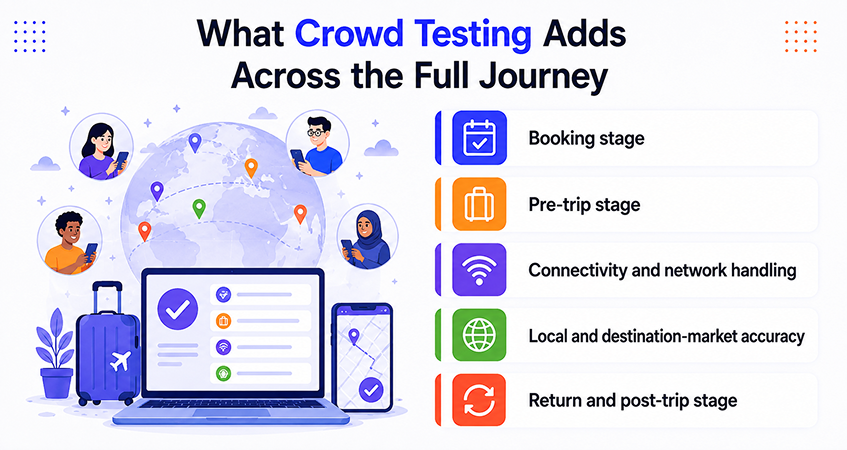
Crowd testing addresses this gap by putting the app in front of real testers, using their own devices, on their own networks, in their own locations, testing the product the way it's actually going to be used, not the way a lab simulates use. For teams newer to the model, the core idea is straightforward: instead of a centralized QA team working through a script in a controlled environment, a distributed pool of testers exercises the app under authentic, varied, real-world conditions and reports back what they find.
Applied across the traveler journey, that looks like this:
Booking stage. Real testers in different countries validate search, pricing, payment flows, and availability using their own currencies, languages, and devices. This catches regional pricing bugs that a single-location QA team, working in one currency and one locale, would simply never encounter.
Pre-trip stage. Testers validate the check-in flow inside the app itself: document upload, itinerary changes, notification delivery under the real conditions travelers are actually in when they check in from home the night before a flight: patchy home Wi-Fi, older devices, spotty mobile data. This is a different kind of check-in testing than validating a physical airport kiosk, and it's the part most likely to get skipped in a lab pass.
Connectivity and network handling. Testers move between Wi-Fi, cellular, and low-signal conditions on their own networks, surfacing exactly how the app behaves during connectivity handoffs and offline states. This reflects the moment a traveler's signal drops mid-journey, without requiring anyone to physically be on a plane or in an airport terminal to validate it.
Local and destination-market accuracy. Testers based in specific destination regions validate maps, wayfinding data, local payment methods, and how language and currency actually display to someone using the app in that market. This catches local map inaccuracies, payment failures, or translation issues before a traveler ever runs into them on the ground.
Return and post-trip stage. Testers validate refunds, itinerary changes, loyalty point updates, and support flows after a booking concludes the part of the journey most apps under-test, precisely because it happens after the "exciting" part is over and QA attention has already moved on.
Crowd testing also covers rideshare and pickup features using real GPS and location data across multiple cities, and it surfaces the kind of UX confusion unclear error states, ambiguous confirmations that a script will pass right through but a real human will stumble on immediately.
Real-World Failure Points Along the Journey
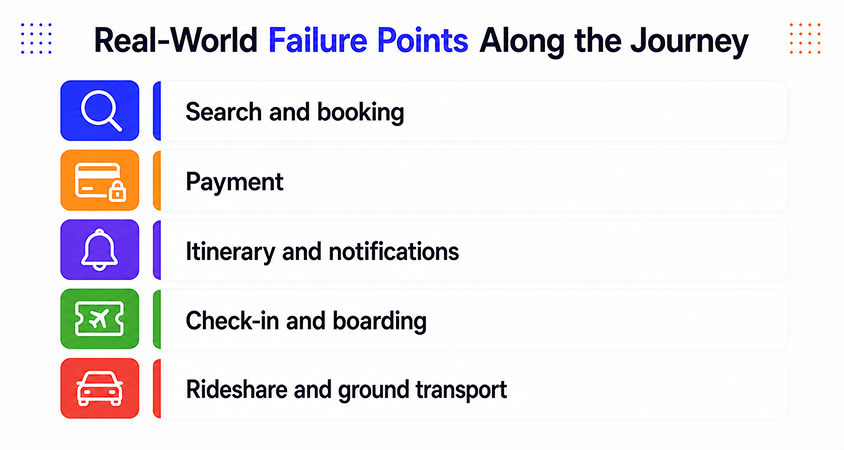
Mapped against the journey, the failure patterns crowd testing is best positioned to catch include:
- Search and booking: slow load times, and incorrect pricing or availability that varies by region
- Payment: failed transactions with international cards or local payment methods
- Itinerary and notifications: sync failures across time zones, missed flight-change alerts
- Check-in and boarding: QR code or boarding pass failures under low signal, gaps in offline mode
- Rideshare and ground transport: GPS inaccuracy, pickup location mismatches
None of these are exotic edge cases. They're the everyday friction points that show up the moment an app leaves the lab and meets real travelers, real devices, and real conditions.
Why This Matters for the Business
A failed booking flow is a lost sale, frustrating but recoverable. A failed in-transit experience is something else: a damaged relationship with a traveler who is already stressed, time-pressured, and in no mood to forgive friction. Trust is disproportionately fragile in travel. A bad app experience during a trip doesn't just annoy the user in that moment; it colors how they remember the entire trip, and how likely they are to open the app again next time.
That fragility compounds as travel and mobility companies expand. Every new market, every new transit partner, every new region adds another set of real-world conditions currencies, payment methods, regulations, network infrastructure that need to be validated before launch. Lab testing doesn't scale with that kind of expansion. Crowd testing does, because it draws on testers who are already embedded in the markets a company is entering.
The Journey Is the Product
Travel apps aren't judged by any single feature in isolation; they're judged by whether the entire journey holds up, from the first search to the boarding gate and beyond. Crowd testing exists to validate that whole journey under the real-world conditions travelers encounter every day: patchy airport Wi-Fi, last-minute rebooking, unfamiliar currencies, a dropped signal at exactly the wrong moment.
If your team is relying on lab QA alone to validate a travel or mobility app, there's a good chance the gaps are invisible until a real traveler finds them. Ubertesters' crowd testing services are built to close that gap: real testers, real devices, real markets, testing the journey the way travelers actually experience it. Learn more on our Travel & Mobility testing page