Human Testing vs. AI: The Bugs Only People Can Catch
Picture the dashboard every QA lead wants to see: every AI-generated test passes, the automation suite is green, the AI QA assistant reports no critical issues, and the release is approved. Then launch day arrives, and the support queue fills up anyway. Real users are hitting a payment flow that an AI tester marked as "passed", baffled by a screen that technically works but feels entirely wrong, tapping through a path no test script ever anticipated. The product didn't fail because AI missed obvious defects. It failed because no automated system could fully predict how real people would use it.
AI has changed testing dramatically over the past few years. Modern AI can generate test cases, write and maintain automation scripts, flag anomalies, and compress QA cycles that used to take weeks into days. That's not in dispute. What's also true, and less discussed, is that this same shift has created a new category of bugs the ones that only a human tester reliably catches.
This isn't an AI-versus-human testing debate. It's about understanding where each delivers the greatest value as part of the modern QA strategy. AI excels at speed, scale, and repetition. Human testers excel at context, intuition, and discovering the unexpected. The most effective QA strategies combine both, and that's exactly what this article explores.
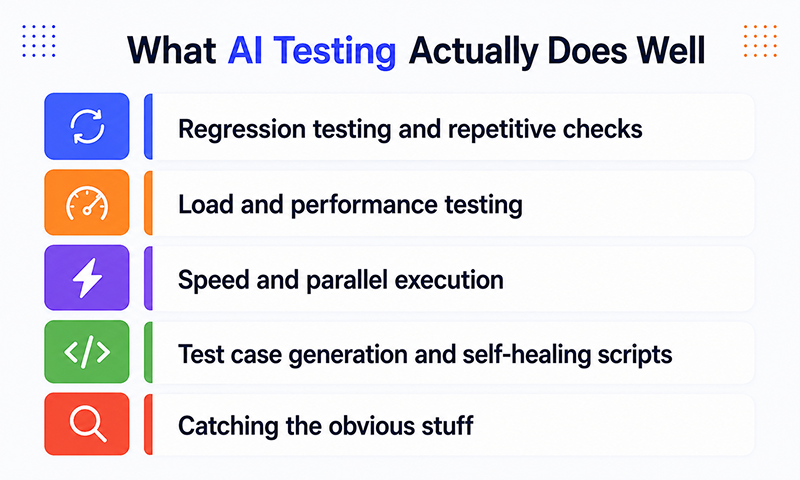
What AI Testing Actually Does Well
Give AI-driven testing tools credit where it's due; they've earned their place in the modern QA stack, and any honest comparison of AI testing vs. human testing has to start by acknowledging that.
Regression testing and repetitive checks
Anything that needs to be run the same way, over and over, across builds is a natural fit for automation. AI-assisted regression suites catch the "did we just break something that used to work" problem far faster than any human ever could, and they do it without fatigue, without skipped steps, and without the boredom that creeps into a manual tester running the same click-path for the two hundredth time.
Load and performance testing
Simulating thousands of concurrent users, measuring response times under stress, finding the point where infrastructure buckles- this is fundamentally a scale problem, and AI QA testing tools are built for scale. No human team, however large, can generate the kind of concurrent traffic needed to stress-test a system the way a well-configured load testing tool can in a matter of minutes.
Speed and parallel execution
Thousands of test cases can run simultaneously across environments, configurations, and devices. What used to take a QA team days can now happen overnight, which means release cycles that used to be measured in weeks can now be measured in days without sacrificing basic coverage.
Test case generation and self-healing scripts
AI can generate new test cases from existing patterns and automatically adjust scripts when the UI shifts slightly, cutting down the maintenance overhead that used to eat up so much QA time. This is one of the more underrated shifts of the last few years: teams used to lose enormous amounts of engineering time just keeping test suites from breaking every time a button moved. Self-healing scripts have quietly solved a huge chunk of that problem.
Catching the obvious stuff
Syntax-level bugs, broken links, missing elements, functional failures that show up the moment a defined test case runs AI testing catches these fast and consistently, which frees up human attention for the harder, subtler problems that actually require judgment.
It's worth pausing on one specific trend here: vibe coding. As AI-assisted development accelerates how quickly code gets written and shipped, release cycles have gotten faster, but they've also introduced a new wave of AI-generated code bugs that traditional test suites weren't designed to catch, because the code itself was never fully understood by a human in the first place. When a developer accepts an AI-generated function without fully tracing its logic, the resulting bugs often don't look like traditional bugs at all; they look like plausible, working code that quietly does the wrong thing in a specific, hard-to-predict scenario. Testing is arguably the most important step after vibe coding, precisely because it's the only checkpoint left standing between "this looks right" and "this is right."
Key message: AI dramatically improves testing efficiency. It just doesn't improve testing completeness, and that gap, subtle as it sounds, is where things go wrong for a lot of teams that assume a green dashboard means a safe launch.
The Blind Spots: What AI Testing Misses
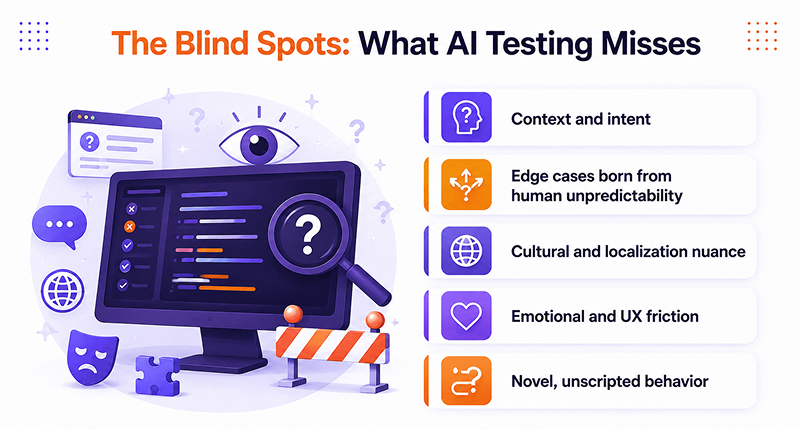
AI testing is exceptional at validating what was defined. The problem is everything that wasn't and that "everything" is larger and more consequential than most QA roadmaps account for.
Context and intent
AI doesn't know what an app is supposed to feel like for a real person, in a real moment, under real pressure. It can confirm that a button triggers the correct function. It cannot tell you that the button is in a spot no user will think to look, that the copy above it reads as vaguely threatening, or that the flow around it feels wrong even though every individual step technically works. Context is exactly what's hardest to encode in a test case, because it lives in the gap between what a screen does and what a person expects it to do.
Edge cases born from human unpredictability
Real users test software in ways no script anticipates: an unusual device, a spotty hotel Wi-Fi connection, a phone call interrupting a checkout flow, someone using an app one-handed on a crowded train while holding a coffee in the other hand. A test environment is, by design, controlled and predictable. Real usage is neither. These aren't edge cases in the traditional QA sense of "rare and unlikely" for a meaningful slice of any real user base; this is just Tuesday.
Cultural and localization nuance
A phrase that reads naturally in one market can land as awkward, confusing, or even offensive in another. Payment habits differ by region; a flow that assumes a credit card as the default option can quietly alienate markets where mobile wallets or cash-on-delivery dominate. Local regulations shape what "compliant" even means, and those regulations shift by jurisdiction in ways a generic test suite has no visibility into. None of this translates through a scripted test case; it requires a person who actually lives inside that context, speaks the language, and understands the local norms well enough to notice when something is subtly off.
Emotional and UX friction
This is the heart of the difference between UX testing vs. functional testing. A flow can be 100% functional: every tap registers, every screen loads, every API call returns the right response, and still be confusing, frustrating, or just "off" in a way that erodes trust and drives users away. Automated testing has no concept of "off." It has no concept of hesitation, of a user who almost abandoned a form three times before finishing it, of a confirmation screen that technically confirms the right thing but leaves the user unsure whether it worked. Those moments don't throw errors. They just quietly cost conversions.
Novel, unscripted behavior
Real users don't follow test scripts. They tap the wrong thing, get impatient, back out halfway through a form, refresh at the worst possible moment, and go rogue in ways no QA engineer wrote a test case for because nobody could have predicted it in advance. This is precisely the kind of behavior that separates a QA process built around predefined scenarios from one built around genuine exploratory curiosity.
The important distinction here: AI validates what was defined in advance. Humans discover what nobody expected. That single sentence answers most of the "can AI replace manual QA testers" debate on its own because the entire value of manual testing lives in the space AI wasn't told to look at. Ask "what bugs does automated testing miss," and the honest answer is: precisely the ones nobody thought to write a test for, which in a mature product is usually the majority of what's left to find.
Where Crowd Testing Fills the Gap
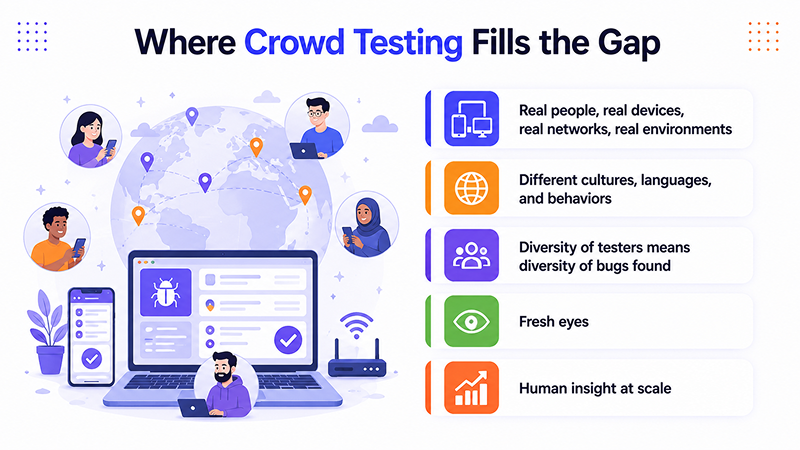
AI can execute predefined tests at extraordinary speed. What it cannot do is replicate the sheer diversity of real people interacting with a real product, in real conditions, for the first time. That's exactly the gap crowd testing was built to close, pairing human judgment with broad, real-world coverage at a scale no internal QA team can match alone, and no lab environment can convincingly fake.
Real people, real devices, real networks, real environments
Crowd testing validates software under conditions no AI model or internal lab can fully reproduce: a five-year-old Android phone with a cracked screen, a patchy 3G connection in a rural area, a browser configuration nobody on the internal team still uses, an app being tested across multiple networks and regions where latency and connectivity behave completely differently than they do on an office Wi-Fi network. Internal QA teams, however well-resourced, are still testing from a handful of devices and one or two office networks. Real device testing at crowd scale closes that gap by design rather than by approximation.
Different cultures, languages, and behaviors
People from different countries and backgrounds interact with the same software differently, and those differences aren't cosmetic they change what "works" actually means. Crowd testing surfaces usability issues, localization mistakes, and unexpected workflows that scripted tests never consider, because the test writer, sitting in one office, in one country, speaking one primary language, never thought to look for them in the first place.
Diversity of testers means diversity of bugs found
Different OS versions, different regions, different accessibility needs, different payment methods, different assumptions about how a form should behave the wider the pool of real device testing participants, the wider the net for catching what actually matters to actual users. A bug that shows up only on a specific older Android version, only for users navigating with a screen reader, or only when paying through a regional wallet provider will simply never surface in a lab that doesn't include those conditions.
Fresh eyes
Crowdtesters aren't biased by months of familiarity with a product. Internal teams develop blind spots precisely because they know the product too well; they've learned to work around the confusing flow without even registering that it's confusing. A crowdtester notices it immediately, because they're seeing it for the first time, the same way a brand-new user will on day one.
Human insight at scale
This is the real answer to "what can crowd testing catch that AI can't": while AI scales automation and repetitive validation, crowd testing scales human observation, intuition, curiosity, and real-world decision-making - across hundreds or thousands of testers simultaneously, each one bringing a slightly different device, mindset, and set of expectations to the same product.
Key message: AI scales speed. Crowd testing scales human intelligence. Together, they deliver software that doesn't just work technically - it succeeds in the hands of real users, in real conditions the team building it may never have personally encountered.
The Hybrid Model: AI + Crowd Testing, Not Either/Or
The most useful way to think about this isn't AI testing vs. human testing as competitors fighting for the same job. It's a QA stack, with each layer doing what it's actually good at, and each layer covering the other's blind spots.
- AI is the first line of defense - speed, repetition, scale. It catches regressions fast, runs load tests overnight, clears the obvious functional failures, and keeps test suites current without constant manual upkeep, all before a human ever needs to look at the build.
- Crowd testing is the second line - judgment, context, real-world chaos. It's where the limitations of automated testing get covered: the bugs that only show up when a real person, on a real device, in a real place, with real motivations and real impatience, tries to actually use the thing the way it was meant to be used.
Neither layer is optional if the goal is genuinely high-quality software. A team that skips the AI layer is choosing to move slowly and burn manual-testing hours on repetitive checks a script could handle in seconds. A team that skips the human layer is choosing to find out about its worst bugs from angry users instead of from testers, which is a far more expensive way to learn the same lesson.
This hybrid QA strategy is quickly becoming the industry standard, and for good reason. Teams that rely purely on automation ship fast and then spend the following weeks fighting a support ticket backlog, patching issues that a single round of real-world testing would have caught before launch. Teams that rely purely on manual testing move too slowly to keep up with modern release cycles, and burn out their QA staff on repetitive checks that add little value beyond confirming nothing broke. The teams getting it right run both, deliberately, as complementary layers rather than a philosophical choice between them, treating "human testing vs AI" less as a debate to settle and more as a resourcing decision to get right.
In practice, this usually means AI-driven automation runs continuously against every build, catching regressions and performance issues immediately, while crowd testing gets brought in at key milestones before a major release, after a significant redesign, when entering a new market, or when a product first needs real-world validation across different networks and regions. The cadence differs by team, but the principle holds everywhere: automation for what's known and repeatable, humans for what's unknown and unpredictable.
Conclusion: Software Is Built for Humans. It Should Be Tested by Humans Too.
AI is transforming QA, and it belongs in every modern testing strategy. But software quality has never been just about finding defects. It's about understanding how real people experience software, friction and all. A test suite can be entirely green and still fail real users because passing automated tests and delivering a great user experience are not the same thing.
The bugs that hurt the most in production, the ones that cost trust, revenue, and customer retention, are often buried in context, local nuances, unexpected user behavior, and real-world conditions. As AI-assisted development and AI testing continue to accelerate, validating those experiences becomes even more important.
The highest-performing engineering teams won't choose between AI and human testing. They'll combine AI's speed with the judgment, creativity, and context that only people provide. By integrating crowd testing into their QA strategy, they gain real-world testing across diverse users, devices, environments, and cultures, uncovering the issues automation alone is likely to miss. That's how modern software testing delivers products that don't just pass tests, but succeed in the hands of real users.
Ready to see how your app performs in the hands of real testers on real devices? Contact Ubertesters today for a customized crowd testing consultation and find out what your automation suite isn't telling you.