What Breaks When You Switch a PSP. Why Only Crowd Testing Catches It
Months go into the preparation for a PSP switch. Integration passes the quality assurance checks, internal testing is successful, and the go-live date is set for Friday. Monday comes, and there is a drop in checkout conversion in Germany, failed Visa debit transactions in Brazil, and an inability by Android users to transact using wallets in Southeast Asia.
This is the reality of a payment service provider migration. It might seem like just an update on the backend; yet, even minor adjustments to the payment flow, authentication process, or tokenization can impact conversion right away. People tend to think that when you switch your payment service provider, you will only replace an API. But that’s not the case.
What Actually Changes When You Switch a PSP
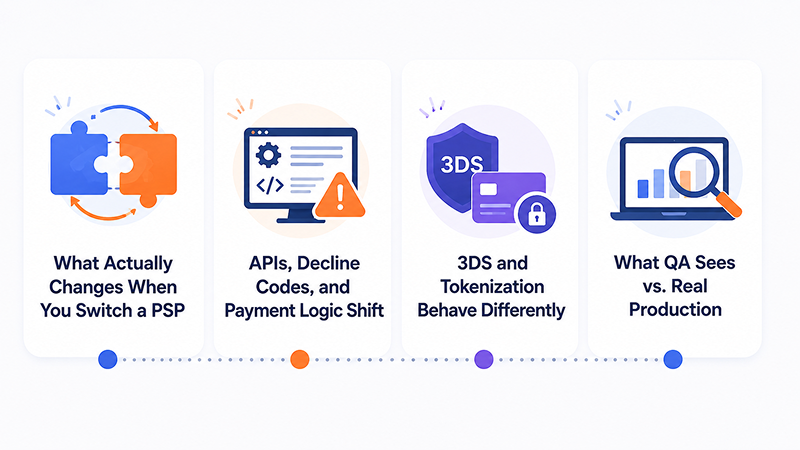
There is far more to a PSP switch than just altering the payment gateway. Even adding a PSP alongside an existing provider can affect fraud scoring and routing behavior. The fraud guidelines, authorization process, token storage, and authentication procedures could all operate differently post-switch, even though a similar checkout experience is offered.
APIs, Decline Codes, and Payment Logic Shift
Each PSP might handle transaction retries, soft declines, and fraud score evaluation differently. What one PSP might authorize could be rejected instantly by the other. Also, webhooks, settlement, and recurring billing behavior vary, usually creating unseen problems for subscriptions or refunds upon deployment.
3DS and Tokenization Behave Differently
3DS flows are one of the biggest migration risks. Redirect timing, application transfers for banks, and one-time password authentication processes can differ between mobile browsers and local banks. Token migration also poses an important problem, as PSP-specific saved card tokens cannot be transferred to other PSPs.
What QA Sees vs. Real Production
Internal QA usually tests with sandbox cards, stable Wi-Fi, and limited devices. The real user will disrupt any redirect process, change network while checking out, and use an Android device that may have different fragments with banking applications installed locally. Traditional PSP integration testing typically validates expected API responses rather than real customer behavior.
What Typically Breaks After a PSP Switch
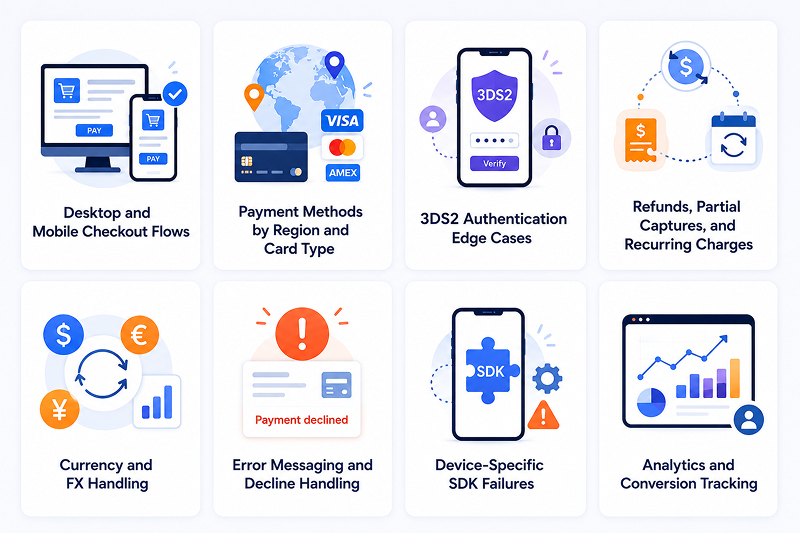
Payment failures following migration do not usually represent catastrophic outages. They consist of minor problems distributed across hardware, payment types, geographies, and post-payment paths. A single payment failure after migration can quietly reduce conversion before teams even notice. The danger is that even minor checkout problems can silently lower conversion rates soon after a release.
Desktop and Mobile Checkout Flows
While desktop checkout can function flawlessly, mobile conversion can plummet instantly. Timing for redirects, autofill functionality, session continuity, and embedded browsers can all shift following a PSP swap. A flow that is successfully tested in Chrome desktop may not work when payment verification occurs in iOS Safari or Samsung Internet.
Payment Methods by Region and Card Type
One of the most common issues is inconsistent payment method availability across regions and devices. Visa debit can malfunction in Brazil alone, Klarna can be unavailable only on certain phones, or local wallets can cease working in Southeast Asia. Such problems generally arise only when dealing with live issuers and regional banks.
3DS2 Authentication Edge Cases
3DS2 failures are particularly devastating because users do not attempt authentication again. Problems include faulty redirects from bank applications, never-ending loading screens, unsuccessful OTP submissions, and session expiration during authentication. According to Adyen, poorly optimized 3DS flows negatively impact checkout conversion rates because users drop off during authentication.
Refunds, Partial Captures, and Recurring Charges
Refunds and subscriptions receive less testing than the checkout process. Many businesses only notice recurring payment issues several days after launch. Post-migration, businesses experience failures with subscription renewals, duplicate charges, broken partial refunds, and discrepancies in transaction statuses between the PSP and internal systems.
Currency and FX Handling
Each PSP treats exchange rates, rounding methods, and settlement differently. Even minor differences in foreign exchange may cause accounting mismatches, calculation errors in customer balances, and a lack of reconciliation for overseas transactions.
Error Messaging and Decline Handling
The decline code and message displayed to customers may be updated following migration. Generic error messages, such as “transaction failed,” result in more retries and helpdesk calls, as customers cannot determine whether the problem originated at the bank, during authentication, or with the payment method.
Device-Specific SDK Failures
Mobile SDK behavior varies widely across providers. Problems may arise only for specific OS versions, specific Android manufacturers, or even older app versions. It is hard to reproduce this kind of problem internally due to actual fragmentation. These bugs usually appear only during real device payment testing.
Analytics and Conversion Tracking
The analytics will most likely fail silently during the migration between PSPs. Some transactions will appear successful even though they are failures, and drop-off points will be hidden in the funnel.
Why Standard QA Misses Payment Issues
Payment issues generally arise only after the system is used by real customers, which is why such bugs are not caught during internal testing prior to launch.
Limited Device, Browser, and Card Coverage
The internal team may test on a small set of devices, browsers, and test credit cards. Nevertheless, this rarely reflects real consumer usage of different browsers, older phones, local debit cards, and mobile wallets. Internal teams rarely achieve enough payment QA coverage for real-world conditions.
Staging Does Not Behave Like Real Banking Systems
The sandbox provides issuers with an easier way to perform screening, detect fraud, and verify transactions. Even a transaction that works perfectly in the staging system may not work with live banks.
Internal Testers Behave Differently
Employees already know the checkout flow. Real customers retry failed transactions, exit redirects, and change from Wi-Fi to mobile internet during the authentication phase.
Regional Issues Are Hard to Reproduce
Some problems occur only in certain countries, networks, or banking apps, especially when validating 3DS and wallets.
Automation Cannot Test Real Checkout Experience
Automated testing will identify any broken code paths, but it cannot simulate human hesitation, redirection issues, or payments made on a particular device.
Why Crowd Testing Finds Payment Issues Internal QA Misses
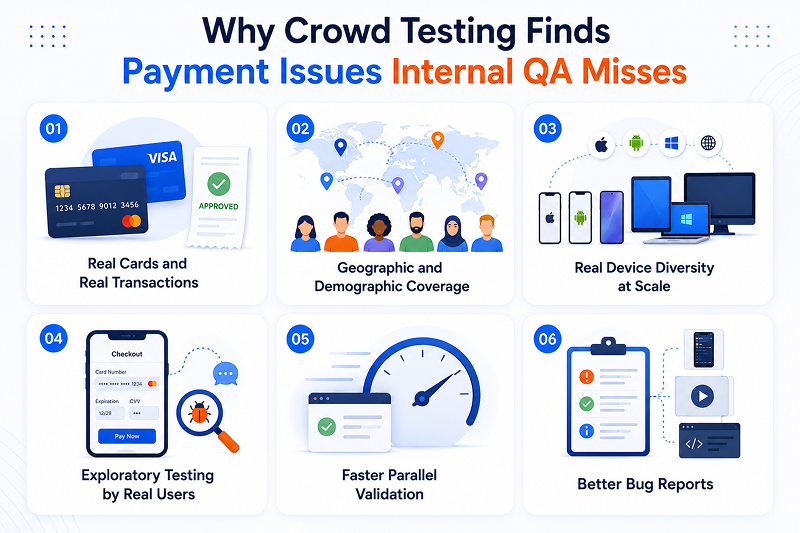
Why Crowd Testing Finds Payment Issues Internal QA Misses
The majority of payment-related bugs become evident in real-life environments. This is precisely the point of importance for crowd testing payments.
Real Cards and Real Transactions
Crowd testers use actual bank cards, wallets, and banking apps rather than sandbox credentials that bypass issuer validation and anti-fraud scoring processes.
Geographic and Demographic Coverage
A payment process that operates flawlessly in the USA might not work in Brazil or Germany due to differences in local bank practices and regulations.
Real Device Diversity at Scale
Crowd testing provides access to environments that internal QA does not cover, including older Android devices, embedded webviews, and outdated iOS versions.
Exploratory Testing by Real Users
Real users interrupt redirects, retry failed payments, switch networks during 3DS, and behave unpredictably. Those actions expose issues that scripted tests usually miss.
Faster Parallel Validation
Rather than testing each region and device individually, crowd testing teams can verify multiple payment methods and countries across multiple devices simultaneously.
Better Bug Reports
Professional crowd testers have access to highly descriptive test reproduction steps, videos, device logs, screenshots, and issuer-specific information that make reproducing and fixing payment issues fast and easy.
How to Structure a Crowd Testing Cycle for a PSP Switch
 ++
++
The successful PSP switch should be considered a conversion-critical product launch rather than a standard backend change. Even minor issues with 3DS verification, redirects, or local payment processing can cause a drop in checkout conversion rates.
Before You Start
Prior to migration, run crowd testing on the current PSP to establish a baseline for:
- Checkout completion by country
- 3DS success rates
- Wallet-specific failures
- Mobile vs desktop conversion
Without baseline data, it becomes difficult to identify whether the new PSP caused post-launch conversion drops. The scope of the test must be narrowed down specifically to include countries, devices, payment methods, subscriptions, refunds, and local wallets that must be tested.
Test scenarios need to incorporate typical use cases, as well as real payment testing edge cases that account for various scenarios, such as invalid OTP entry, broken redirects, expired sessions, and poor mobile network connectivity. The test environment needs to simulate production-level fraud detection mechanisms and payment routing, since sandbox banks rarely behave like real banks.
During Testing
Run both scripted and exploratory testing checkouts simultaneously. Scripted tests ensure that expected processes run correctly, whereas exploratory testers act just like regular customers by repeating failed payment attempts, changing networks during 3D Secure, or stopping mid-way through the checkout process. Focus a lot on high-risk areas, such as:
- 3DS2 authentication
- Mobile wallet flows
- Local payment methods
- Subscription renewals
Use real cards and banking apps wherever possible since test credentials often don’t require issuer validation and are exempt from fraud scoring. Bugs must be triaged daily to prioritize conversion-blocking issues.
Exit Criteria
If crucial payments are still not working in target markets, the migration is not ready for production despite passing integration tests. Each payment flow must be thoroughly tested, including refunds, recurring billing renewals, confirmation emails, and failed-payment recovery flows.
Go-Live and Monitoring
The best way to launch the product would be through a soft launch, without redirecting all traffic. During the first few days after launch, keep track of authorizations, checkout abandonment rates, wallet authentication failures, and regional conversions in real time. Teams should also prepare for rapid payment regression testing after fixes go live. It is important to have crowd testers available post-release to replicate issues within the production environment.
What a PSP Switch Really Means
A PSP switch is never just a technical migration. It is a customer experience event. Passing integration tests only proves that systems can communicate. It does not prove that real customers can complete payments smoothly across real devices, banks, regions, and network conditions.
The only reliable way to understand what breaks during a payment service provider migration is to test payments exactly the way users experience them. That is what crowd testing is built for.
Planning a PSP migration or validating a recent one? Talk to Ubertesters about how we test payment flows under the real conditions your users actually live in.