Global App Launch: How to Test Before You Go Live Worldwide

A well-funded startup. Development over months. All tests passed within the company. Simultaneous release in five markets. Three fail within 72 hours. Failing crashes on phones they never tested. Payment is silently failing. Date format nonsense, ratings plummeting.
Not hypothetical, this happens constantly. In 2026, users do not troubleshoot; they just uninstall. One malfunctioning payment interface in a brand-new market will cost you a customer forever. Moving from being local to global appears easy, but “ready for global launch” requires that your app should be able to work for a user in Lagos on 3G with a budget Android, for someone in Riyadh on an RTL interface, and for a user in São Paulo paying with Pix.
Same app. Completely different reality. This is for PMs, QA leads, and mobile teams heading into international expansion. Here’s what you actually need to test. This is where mobile app international launch strategies often fail without proper preparation.
Why Global Launches Fail
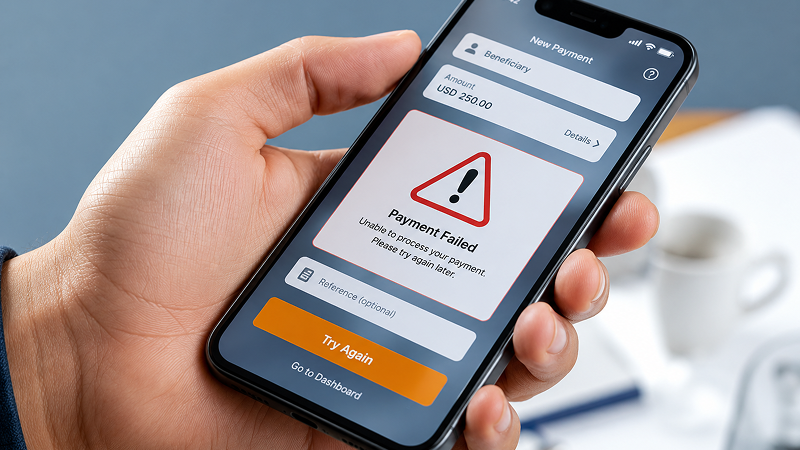
Global launches do not fail because of the poor quality of the product. They fail because the team tested the wrong things, without a proper global QA testing strategy in place.
Your Home Market Is a Bubble
What works flawlessly on your team’s devices, typically flagship phones on fast Wi-Fi, tells you almost nothing about how the app behaves everywhere else. Different markets require different approaches. This is why app testing by region is critical before expanding globally.
Device Fragmentation Is Worse Than You Expect
Your device environment looks different everywhere else except your own domestic market. Most emerging markets have budget and mid-tier Android devices, which run outdated or modified versions of the OS and hardly resemble regular Android.
Network Conditions Are Not an Edge Case
The majority of Africa, Southeast Asia, and Latin America operate on 3G connections. If you have not done tests on poor and unreliable networks, then you have not tested your application.
Localization Bugs Hide Until Real Users Appear
Text truncations, incorrect RTL layouts, and improper date format issues seldom emerge during internal testing. It requires native language app testing to uncover real-world issues.
Bugs Found After Launch Cost Exponentially More
Not just in engineering time. In one-star reviews, refund requests, and churn rates you’ll carry for months.
What Changes When You Go Global
Sending your product to a new market isn’t just about translating your app. Your product is about to be used in ways you never intended it to be used before.
The Device Your Team Uses Is Not the Device Your Users Have
In most growing markets, it is the mid-range and budget Androids that prevail, with some still using old Android operating systems or third-party skins such as MIUI or ColorOS. The skins have their own ways of dealing with permissions, notifications, and background processes, which your internal testing team never considered.
Slow Networks Are the Default, Not the Exception
Across large parts of Southeast Asia, Sub-Saharan Africa, and Latin America, 2G and 3G connections are an everyday reality. Your app needs to be tested under those conditions, not assumed to degrade gracefully.
Localization Goes Deeper Than Translation
Full RTL language support is necessary for the Arabic and Hebrew languages. The length of German and Finnish translations is typically 30-40% greater than that of English translations, which makes the button layouts impossible and cuts off important parts of the interface text. This is where app localization testing becomes critical.
Payment Methods Vary Dramatically by Region
The credit card is not universal. Integration and testing of UPI, GCash, M-Pesa, and Pix all have different considerations and failure points that must be tested.
UX Intuition Is Not Universal
Gestures, navigation, and colors that seem intuitive in one market can cause real confusion in another.
Compliance Requirements Differ by Country
GDPR in Europe, LGPD in Brazil, PDPA in Thailand. Every market comes with its own rules for consent, data management, and disclosure, which need to be developed and tested ahead of release, not afterward.
What to Test Before a Global Launch
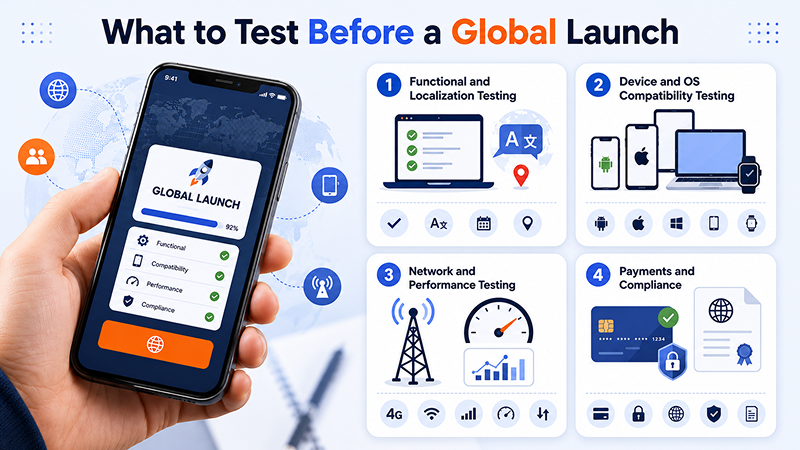
A strong mobile app launch checklist helps ensure nothing is missed. Testing for a global launch isn’t about running your existing test suite in a new language. It requires a different scope entirely.
Functional and Localization Testing
Each critical user flow needs to be tested in each target market, not only in yours. You need to test sign-ups, onboarding, checkout processes, and customer support with local content and real devices. In particular, you have to:
- UI rendering with translated strings and RTL layouts, checking for truncation, overflow, and broken alignment
- Local formats for dates, currencies, and phone numbers verified against actual locale settings, not assumed from a country code
Device and OS Compatibility Testing
Use market share data to develop your test matrix, rather than an internal inventory of devices. In most developing countries, the leading devices are mid-level Android phones that your team hasn’t even laid hands on. Cover:
- Top real devices by market share in each target region
- Budget and mid-range Android handsets that are dominant locally
- Minimum supported OS versions per market, tested on actual hardware
Network and Performance Testing
This is essential for app performance on slow networks. What really matters is how the app responds to dropped connections or loss of data, not just slow loading.
Payments and Compliance
- Local payment methods tested end-to-end, including real failure scenarios
- Currency display verified with actual locale and real card testing
- Consent flows and data handling reviewed against regional legal requirements, including GDPR, LGPD, and local equivalents
The Limits of Traditional Testing Approaches
All teams adopt one or several of these approaches. No single approach alone is sufficient to support a global launch.
In-House QA Teams
Essential, but structurally limited when it comes to international coverage:
- Narrow device and OS coverage, usually skewed toward flagship hardware
- No real network conditions from target markets
- Localization bugs that only native speakers would catch
- Internal testers know the app too well to stumble on genuine UX friction
- Time and resource constraints that tighten as launch deadlines approach
Device Labs and Emulators
Device labs and emulators are great for basic coverage, but let’s be honest, they hit a ceiling pretty quickly. You can’t simulate a user’s frustration on a spotty 4G connection or the weird bugs that pop up only when a real person in a real-world environment opens your app for the first time. They are unable to tets any corner cases. They are also expensive to maintain, require constant device refresh cycles to stay relevant, and still reflect the device choices of the team running them rather than the users you are actually targeting.
Automated Testing
Automation is essential for app regression testing before any major release, but it tests code paths, not human experience. It will confirm that a payment flow executes correctly without telling you that the confirmation screen confused every non-native English speaker who saw it, or that the loading animation on a slow connection makes users think the transaction failed and tap submit twice.
Automated tests are written by people who already understand the app. They will never replicate the genuine confusion, hesitation, or unexpected behavior of a first-time user in a market your team has never visited
Beta Testing With Existing Users
Beta testing with existing users provides useful signal when you already have traction in a market. This tells you absolutely nothing about a new market until you have users there.Your beta users are by definition not representative of the new market you are entering. If you are launching in Brazil for the first time, your existing users in the US or UK will not tell you whether your payment flow works with local Brazilian cards, whether your Portuguese localization reads naturally, or whether your onboarding flow makes sense to someone who has never used a similar product before.
Why Crowd Testing Is Built for Global Launches

The gaps that sink global launches are rarely in your code. They are in your coverage.
Crowd testing puts real certified human testers in your actual target markets, on their own devices and networks, testing your product the way your future users will. Not a simulation. Not a lab approximation. The real thing.
In practice, that means native speakers catching localization issues your team would never spot, local payment methods tested by people who actually use them, and dozens of markets covered in parallel without spending time, allowing you to release as planned.
Bug reports come back with device specs, OS versions, screenshots, and video. Everything your developers need to reproduce and fix fast.
But the most valuable part is harder to put in a bullet point. Real users do not follow scripts. They tap where they should not, misread instructions, and abandon flows not because something is broken but because something felt off. A tester in São Paulo who cannot tell if a confirmation screen is a receipt or an error message is telling you something no automated test ever will.
That is the difference between a product that works in your office and one that works everywhere. This approach also enables effective exploratory testing global launch.
Before You Flip That Switch
Global expansion isn’t simply scaling up what you’re already doing. Every new market is a first impression you only get once. A bad launch does not just mean a rough first week. It means one-star reviews, uninstall spikes, and a damaged reputation in a market you have not even properly entered yet. The distinction is obvious: The companies that win globally are not necessarily the ones with the best product. They are the ones whose product works correctly for every user, on day one, in every market.
The only way to achieve this is through testing in real-life conditions, with real users, real devices, and real network conditions.
Crowd testing is what you do to bridge the difference between your product working in your office environment and its success out in the real world for your global app release.
Planning a global launch in a new market? Talk to Ubertesters about how we test your app in the real conditions your users actually live in.