Africa’s Fintech Frontier: P2P Testing Transforms Transactions
Africa has become the fastest-growing fintech market on the planet. Revenues are projected to expand roughly 13x, reaching approximately $650 billion by 2030. Mobile payment volumes across the continent are expected to surpass $800 billion in the same timeframe. The numbers are staggering, and they're being driven not by Silicon Valley playbooks, but by a continent of people like Amaka who leapfrogged traditional banking entirely and went straight to mobile money.
The promise is enormous. But so is the risk. In peer-to-peer payments, a failed transaction is not just a bug report waiting to be triaged in the next sprint. It's a broken lifeline, for remittances, for small businesses, for families who depend on every naira, cedi, or shilling arriving exactly when and where it should.
Testing isn't a checkbox in this environment. It's the product.
Africa's Payment Problem and the Opportunity Inside It
Fifty-seven percent of sub-Saharan Africa's population remains unbanked. Yet mobile penetration exceeds 80% in key markets like Kenya, Nigeria, South Africa, and Ghana. That gap between financial exclusion and connectivity is exactly where fintech has found its most fertile ground.
The leapfrog effect is real and well-documented: rather than waiting for brick-and-mortar banking infrastructure to catch up, hundreds of millions of people went directly from cash-in-hand to mobile wallets. M-Pesa in Kenya is the canonical example, but it's now just one node in a continent-wide mesh of payment apps, super-apps, agent networks, and cross-border platforms that process billions of transactions a year.
For fintech companies, from global players entering the market to local startups scaling fast, the opportunity is generational. But the companies that win won't just be the ones with the best product vision. They'll be the ones whose products actually work, reliably, for real users across Africa's full technological and geographic diversity.
That requires testing that matches the reality on the ground.
Why Testing P2P Payments in Africa Is Uniquely Complex
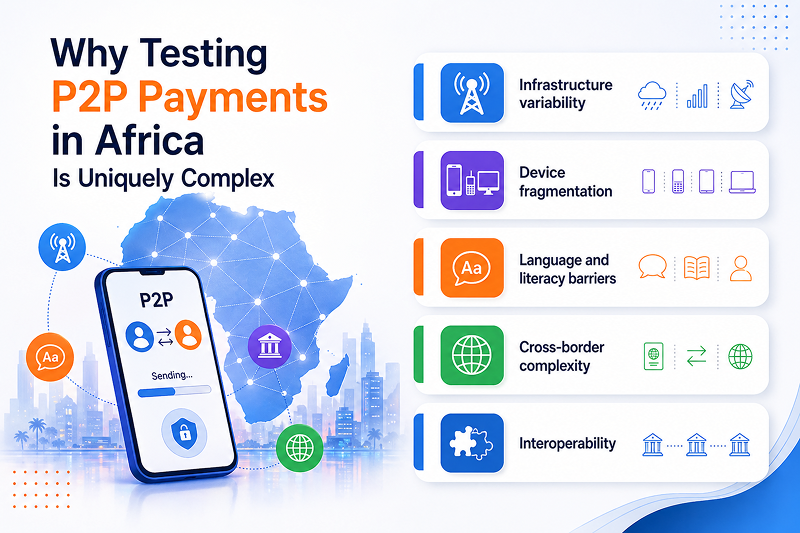
Building a P2P payment product for African markets is hard. Testing it properly is harder still, and the two challenges compound each other in ways that are easy to underestimate from the outside.
Infrastructure variability is perhaps the most obvious challenge. Coverage maps that show 4G blanketing a region often mask the lived reality: a user in a peri-urban neighborhood may toggle between 4G, 3G, and EDGE within a single session. A product that performs flawlessly on a stable broadband connection can fail catastrophically when latency spikes or the connection drops mid-transaction.
Device fragmentation is equally significant, and often more surprising to teams coming from Western markets. While Samsung Galaxy A-series devices are common, the mid-market in many African countries is dominated by Tecno, Itel, and Infinix handsets devices with different hardware specs, screen sizes, and preloaded software that can interact unexpectedly with payment flows. A UI element that renders perfectly on a flagship device may be invisible, inaccessible, or simply broken on the devices most of your users actually own.
Language and literacy barriers shape not just what users read, but how they navigate. Usability testing in English tells you almost nothing about how French-speaking users in Côte d'Ivoire or Swahili speakers in Tanzania will experience the same interface. Trust, which is essential in financial products, erodes quickly when users encounter language errors, confusing flows, or UX patterns that don't match their expectations.
Cross-border complexity adds another layer. Africa has 54 countries, dozens of currencies, and a patchwork of regulatory frameworks. As systems like PAPSS (Pan-African Payment and Settlement System) mature and new pan-African corridors open, products must navigate currency conversion, cross-border compliance, and interoperability between platforms that weren't designed to talk to each other.
Interoperability between wallets, banks, mobile money operators, and agent networks isn't guaranteed, and failures at the integration layer are among the hardest to catch in a conventional QA process.
What Goes Wrong When P2P Isn't Tested Right
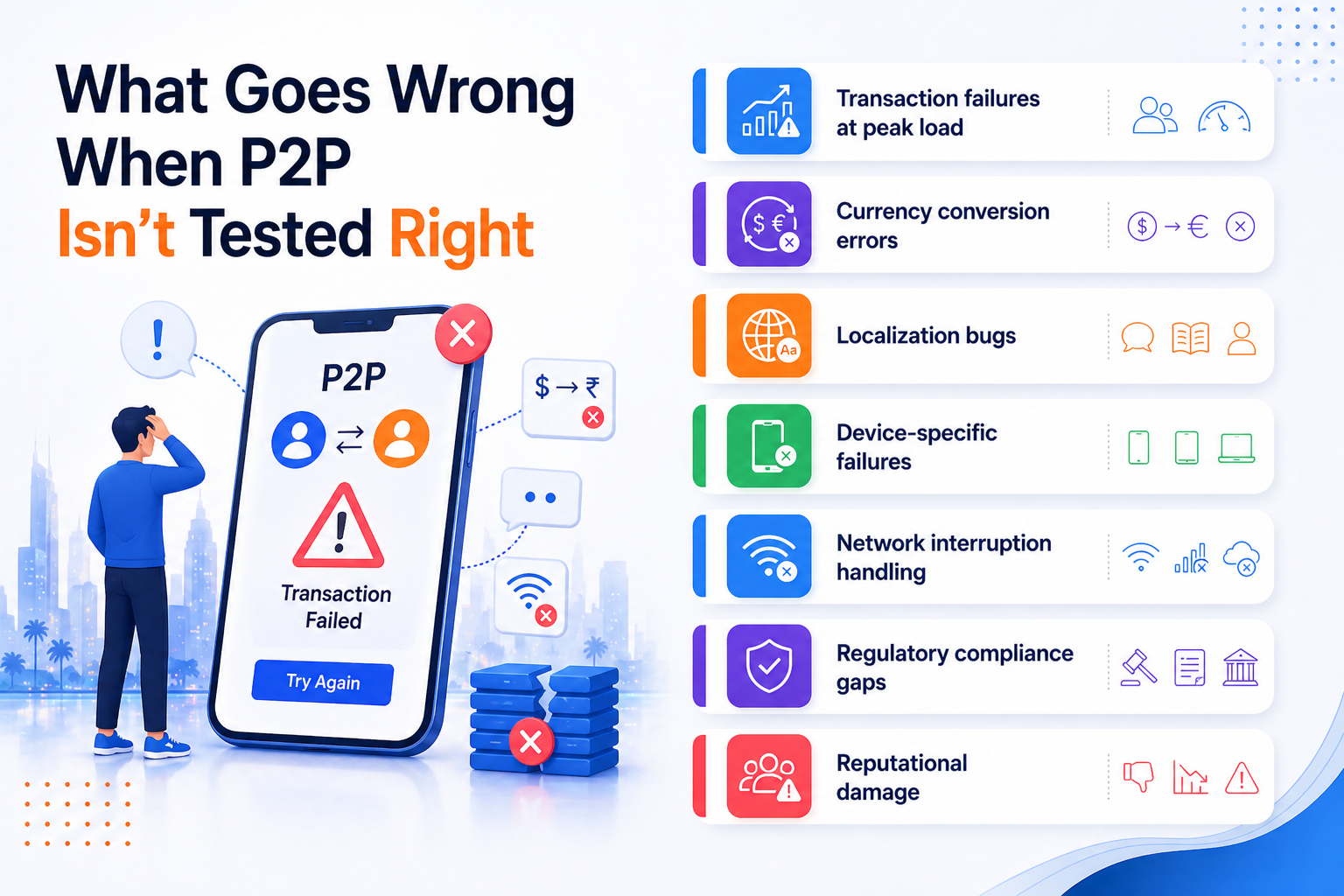
The failure modes in this environment are varied, and many of them are invisible until they happen to a real user in the real world.
Transaction failures at peak load are among the most damaging. Paydays, market days, and major holidays drive transaction spikes that can overwhelm systems not tested under realistic load conditions. When the system fails at exactly the moment millions of people are trying to send money home, the reputational damage compounds the technical one.
Currency conversion errors in cross-border flows are subtle but corrosive. A 0.5% discrepancy in FX calculation might seem trivial in isolation. Multiplied across thousands of transactions and noticed by users who are already margin-sensitive, it destroys trust quickly.
Localization bugs - wrong currency symbols, incorrect date formats, misrendered text in local languages signal to users that the product wasn't built for them. In markets where adoption spreads primarily through word-of-mouth and community trust, this matters far more than in markets with established brand credibility.
Device-specific failures are disproportionately common in African markets precisely because of the device fragmentation described above. A payment button that disappears on a specific version of Android running on a Tecno device is not a theoretical edge case. It's a live bug affecting a significant slice of your user base.
Network interruption handling is the category that produces the most anxiety for users and the most complexity for developers. What happens to a transaction when the connection drops at the moment of submission? Is the user debited without the recipient receiving funds? Does the system retry silently, causing a duplicate charge? Is there a clear recovery path? These scenarios must be explicitly tested, repeatedly, under real-world network conditions.
Regulatory compliance gaps can end a product's presence in a market entirely. KYC and AML requirements vary significantly across jurisdictions, and a compliance failure in one country doesn't just mean a fine it can mean a ban that cuts off your entire user base overnight.
Reputational damage in these markets deserves its own category. In communities where fintech adoption is still maturing and trust is earned slowly, a single wave of failed transactions or a visible bug can generate negative word-of-mouth that takes months to overcome. The cost of a testing failure is not just the immediate incident, it's the churn multiplier that follows.
The Testing Stack: What Good Looks Like
Rigorous P2P testing in African markets isn't a single activity. It's a layered discipline that spans the entire product lifecycle.
Functional testing establishes the baseline: Does the payment go through correctly under normal conditions? But in P2P fintech, "functional" is a floor, not a ceiling.
Payment testing is the core of what separates serious fintech QA from generic app testing. This means validating end-to-end transaction flows with real or simulated money, not just UI clicks. It covers failure and recovery scenarios where a user is debited, but the recipient isn't credited. It validates timeout and retry logic to prevent duplicate charges, a failure mode that is both technically complex and acutely damaging to user trust. It tests fee calculations and FX accuracy, refund and reversal flows, and the triggering of fraud detection systems. In a market where users have no banking fallback, a stuck transaction is not an inconvenience. It is a genuine crisis.
Performance and load testing simulate peak transaction volumes, the payday spike, and the holiday surge to identify breaking points before real users find them. This testing must be conducted under conditions that reflect actual infrastructure variability, not ideal-case assumptions.
Security and penetration testing address the fraud vectors that are specific to African markets: SIM swap attacks, agent network vulnerabilities, and social engineering patterns that differ significantly from those seen in Western markets. Testers who understand the local threat landscape find vulnerabilities that generic security audits miss.
Usability testing with real users across literacy levels, languages, and device types is non-negotiable. The only way to know whether a payment flow is truly intuitive for a low-literacy user in rural Mozambique is to test it with that user or someone very much like them.
Interoperability testing validates that your product works correctly when it connects to other platforms: other wallets, mobile money operators, bank integrations, and emerging pan-African payment infrastructure. These integration points are where some of the most consequential failures occur.
Regulatory compliance testing must be country-specific and continuously updated as regulations evolve. It is not a one-time exercise at launch, it is an ongoing discipline.
Why 20,000 Real Testers Beat Any Lab

Traditional QA labs are built on a fundamental assumption: that you can replicate the user's environment in a controlled setting. For most categories of software, this is a reasonable approximation. For P2P payments in African markets, it is not.
A lab in Amsterdam or Austin cannot replicate a 3G connection that drops and reconnects twice during a single transaction. It cannot replicate the behavioral patterns of a user who has learned to wait three seconds after tapping "send" because that's what their network requires. It cannot surface the bug that only appears on a specific firmware version of a Tecno Spark that's two software updates behind because automatic updates are disabled to save data.
Crowd testing changes the equation entirely. It delivers five (5) advantages that no lab-based QA process can replicate: authenticity, scale, diversity, speed, and cost efficiency.
In crowd testing, a distributed network of real users tests software on their own devices, on their own networks, in their own environments. They are not simulating real-world conditions; they are operating inside them. The result is a category of test coverage that a conventional QA process cannot produce at any cost.
For African markets specifically, the advantages compound. A network of 20,000 testers across 45 African countries running simultaneously doesn't just provide scale, it provides diversity of a kind that is directly relevant to the failure modes described above. French-speaking testers in Côte d'Ivoire will encounter localization bugs that English-only QA will never find. Testers in rural Uganda on 2G connections will surface network-handling failures that 4G lab testing will miss entirely. Testers who use the same Tecno or Itel devices as your actual users will reproduce device-specific bugs that are invisible on the Samsung and iPhone devices stocked in most QA labs.
The result: bug discovery rates that consistently outperform lab-based testing, across device types, network conditions, and language environments simultaneously.
There is also a dimension of community knowledge that no test script can replicate. Testers who live and transact in these markets understand local fraud patterns, agent network behaviors, and user expectations in ways that external QA teams cannot. They know when something feels wrong before they can articulate why, and that intuition surfaces bugs that structured test scripts would never catch. This is the difference between a tester executing a checklist and a real user telling you the truth about your product.
The operational advantages are significant as well. Crowd testing compresses test cycles from weeks to days. It costs a fraction of equivalent lab-based testing. And it scales elastically; a team can go from 50 testers to 200 in days when a product launch requires it.
The combination of speed, scale, authenticity, and diversity makes crowd testing not just a complement to conventional QA in this market. It makes it the only method that covers the full reality of what your African users actually experience. Everything else is an approximation.
The Stakes Are Only Going Up

Africa's fintech boom is not a temporary phenomenon. The structural drivers mobile penetration, a young and growing population, persistent gaps in traditional financial infrastructure, and an entrepreneurial ecosystem that is producing world-class fintech companies, are not going away.
The P2P payment market specifically is entering a phase of acceleration, as pan-African payment systems mature, cross-border corridors multiply, and the companies that built dominant positions in single markets begin competing for the continent-wide prize.
In this environment, the companies that win will not simply be the ones with the most elegant product vision or the most aggressive go-to-market strategy. They will be the ones whose products work reliably, consistently, for real users across the full spectrum of devices, networks, languages, and conditions that define daily life across Africa's diverse markets.
Testing is not a cost to be minimized or a phase to be compressed. It is a competitive advantage. The gap between what a product does in a QA lab and what it does in the hands of a user in Ibadan, Nairobi, or Accra is exactly the gap that determines whether that user trusts the product or tells everyone they know not to.
Your Users Aren't Waiting
Your users in Nairobi, Lagos, and Accra aren't waiting for perfect infrastructure. They're transacting now, on the devices they have, on the networks available to them. The question is not whether your product will be tested; it will be, by the market, in real time. The question is whether you find the failures before your users do.
Ubertesters deploys a verified network of real testers across Africa, testing payment flows on actual devices, real networks, and authentic user conditions, the Tecno Spark in Ibadan, the 2G connection in rural Uganda, and the French-language interface in Abidjan. If you're launching or scaling a P2P product in Africa, let's talk about what your QA setup might be missing.