How Mystery Shopping Testing Improves Checkout Experience and Payment Success
A customer adds $347 to their cart, clicks “Checkout,” and disappears. There is no error message. There is no support ticket. There is no purchase. It is happening much more often than companies expect. Research has consistently demonstrated that 7 of 10 online shoppers never complete a purchase after adding items to a cart. Cart abandonment is not a UX metric. It is lost revenue after your marketing has worked. You got the customer to want the product. You lost them at the point of payment.
The analytics tools show a funnel. They tell you where users dropped off. They rarely tell you why. A failed payment might be logged as “transaction declined,” but to the customer, it feels like a risky transaction or a broken website.
This gap between data and experience is exactly what mystery shopping testing solves. It shows what users actually go through during the highest-anxiety moment in your product: the decision to pay.
Why Checkout Experience Is So Fragile

Checkout is not just another screen; it is a psychological trust test. Users are no longer just browsing. They are assessing risk, and small issues can change a behavior.
Small Issues Equal Instant Abandonment
Real usability research shows people abandon checkout for surprisingly minor reasons. For example:
- 24% leave when forced to create an account
- 17% leave when checkout feels too complicated
- 16% leave because the total price is unclear
Even a required phone field without any explanation will lead to measurable abandonment. That’s the reason checkout experience testing is important. A checkout process works correctly, but still fails the user.
Emotional Factors at Checkout
By the time payment is made, customers are no longer thinking about your product. They think about safety.
They evaluate:
- Can I get a refund?
- Will I be charged twice?
- Is this site legitimate?
Around 18% of users will abandon their purchase path because they don’t feel comfortable providing card details. That is not a technical problem. That is a perception problem. That is where payment UX testing becomes a critical component.
Users Don’t Report Problems
Companies expect support tickets, and customers rarely submit them. When a checkout fails, users simply open another tab and buy elsewhere. Studies show that most people abandon after technical errors rather than retry. To reduce checkout abandonment, you must observe behavior directly.
Why Traditional Testing Misses Checkout Failures
QA teams test functionality. Customers experience journeys. Those are not the same thing.
Automation Limitations
Automation verifies system responses such as:
- success status
- API responses
- gateway callbacks
But automation cannot detect hesitation or confusion. This is why payment flow testing often passes internally yet fails with real users.
Internal QA Blind Spots
Internal testers know what should happen next. A user does not.
For example, in the case of banking authentication (3D Secure), it is required to prevent fraud. At the same time, it appears suspicious to users since the payment page suddenly redirects to a different site. Security research has shown that balancing security and user experience is a challenge in current electronic commerce payment systems. Mystery shopping reveals this.
What Is Mystery Shopping Testing for Checkout & Payments
Mystery shopping simulates real purchasing behavior rather than controlled testing. It evaluates the entire journey, not individual features.
The Methodology
Testers use:
- their own devices
- real internet connections
- real credit cards and wallets
They actually buy the product. This is real user payment testing and end-to-end payment testing.
Functional Testing vs Experience Validation
Traditional payment gateway testing answers: Did the transaction technically work?
Mystery shopping payment testing answers: Did the customer feel comfortable completing it?
This approach is especially useful for:
- fintech products
- subscription services
- marketplaces
- global eCommerce
How Mystery Shopping Testing Improves Checkout Experience and Payment Success
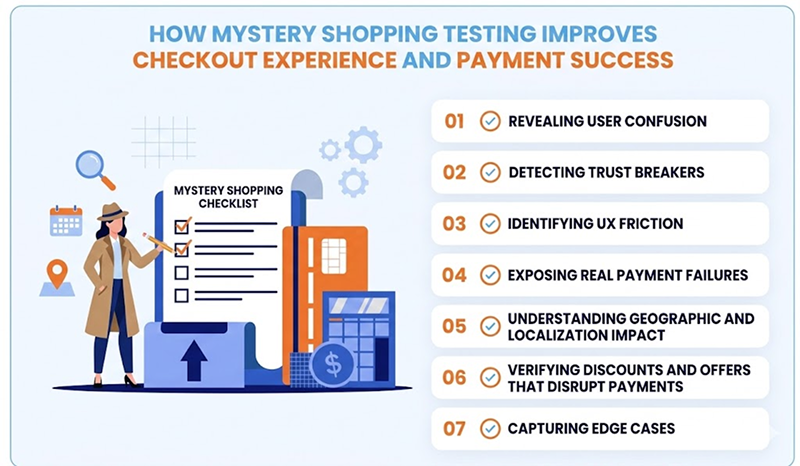
Real-life experience exposes issues that are not apparent in analysis. Analysis provides data on conversion percentages, but not on hesitation, confusion, or mistrust. In reality, failed payments are often psychological or situational rather than purely technical.
Revealing User Confusion
Testers often hesitate during simple steps:
- entering address format
- Understanding shipping timing
- recognizing confirmation pages
Many customers are unsure whether their orders are complete. This leads to actions such as reloading the page or trying to make the payment again, which, in turn, cause duplicate authorization holds. Usability studies have shown that the complexity of the checkout process alone causes a large percentage of abandonment, and small issues with clarity can stop a purchase in its tracks.
Fixing wording, confirmation states, and guidance alone can significantly improve checkout conversion optimization.
Detecting Trust Breakers
Common trust issues include:
- unfamiliar payment redirect domains
- inconsistent merchant names
- missing confirmation emails
This is what the customers identify as fraud. Once the banks verify the payment, it redirects the customer to another page. If the design changes, the customers identify it as a phishing scam and cancel the transaction.
Identifying UX Friction
Identifying checkout friction points frequently exposes small but critical usability barriers:
- Mobile keyboards wrong for card numbers
- auto-fill not supported
- unclear CVV location
Even form length matters. Research indicates that many users abandon the checkout process when they perceive it as too lengthy or complex, especially on mobile devices. A series of minor usability improvements can be more effective than any marketing campaign because these improvements can win back users who have already made up their minds to buy.
Exposing Real Payment Failures
Payment dashboards might indicate 90-95% success rates, but authorization data reveals the following interesting fact: a significant percentage of payment attempts technically fail after the customer has committed to the payment attempt. According to industry data, 15-20% of all e-commerce payment attempts fail in the authorization step.
Only real money payment testing reveals:
- bank declines by region
- retry failure loops
- authentication timeouts
Banks might decline transactions due to suspected fraud, insufficient balances, daily limits, or delays in one-time password verification. This would help companies avoid payment failures.
Understanding Geographic and Localization Impact
Cross-border payments behave very differently from domestic ones. Some banks reject international merchants entirely, while others require extra authentication steps. Delays in SMS verification codes are also common when customers travel or use roaming networks.
Because of these factors, international transactions frequently fail due to payment compatibility or regulatory checks. That makes payment localisation testing essential.
Verifying Discounts and Offers That Disrupt Payments
Promotions often fail under real conditions. During e-commerce checkout testing, mystery shoppers verify:
- bundle discounts
- regional offers
- peak-traffic coupons
In many cases, discounts are correctly applied in staging environments but not in production, due to tax rules, currency, or region-based pricing. This directly influences conversion rates because price changes during checkout are among the top reasons for abandoning a purchase.
Capturing Edge Cases
Users behave unpredictably:
- They refresh pages
- switch devices
- retry payments quickly
Real customers also interrupt flows, lose connection, or reopen checkout later. These behaviors often cause “stuck” authorizations or duplicate payment attempts. Only live payment testing services can effectively uncover these types of issues, as they are difficult to replicate in a scripted QA environment due to customer impatience.
The Role of Crowd Testing in Mystery Shopping
Payment behavior varies significantly across demographics, regions, and user types, making it impossible for a small internal team to simulate real-world checkout scenarios. Crowd testing provides the scale and diversity needed to understand how different customers actually interact with payment processes across various contexts and conditions.
Why Scale Matters in Payment Testing
When transactions are tested simultaneously across regions, real issues appear. In fact, about 40% of shoppers will leave the checkout process after a payment failure, and one in three will never attempt to complete the purchase. Reliability, in this case, directly translates to revenues. Large-scale tests enable the team to understand the impact of authentication delays, bank declines, and confirmation times on the customers rather than relying on log files.
Coverage Across Real Environments
Crowd testers execute purchases using different:
- countries and currencies
- devices and browsers
- OS versions and networks
- banks, cards, and digital wallets
Currently, more than 300 payment options are supported worldwide. This means a payment system that works in the staging environment could still fail in the production environment. This ensures cross-border payment problems are visible.
Demographic Insights & Pattern Discovery
A crowd reveals patterns, not individual bugs. As already mentioned, 70% of users abandon their shopping carts, and nearly 18% do so because the process is too complicated, according to usability testing. Testers get stuck in various places: some during redirects, others during long forms. Observing patterns in user behavior helps to differentiate actual pain points during the checkout process from technical issues.
What a Mystery Shopping Payment Test Looks Like
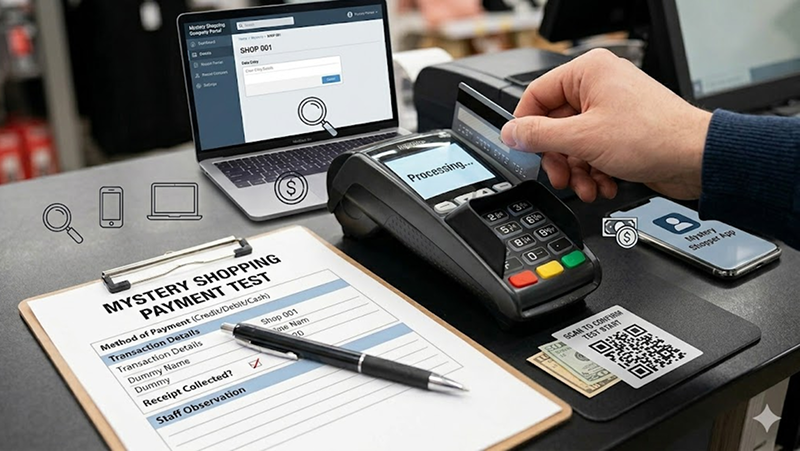
Mystery shopping focuses on real purchase behavior, not scripted QA.
Typical Scenarios
A project usually includes:
- first-time purchase with an unfamiliar payment method
- high-value purchase
- declined card retry flow
- currency switching
- coupon usage
- refund request
These scenarios help improve payment conversion rate.
Tester Instructions
Testers are instructed to behave naturally.
They document:
- hesitation
- confusion
- comparison instincts
This demonstrates how to test payment flows with real users.
Deliverables
Reports include:
- narrative experience walkthrough (not just bug reports)
- screenshots and videos
- Severity ratings (Critical: blocks payment | High: causes hesitation | Medium: minor UX issue)
- quantified findings ("7 out of 10 testers couldn't find PayPal option")
- business impact analysis
This transforms testing into actionable conversion insight.
The Cost of Invisible Friction
The checkout is where product value is realized as revenue. Yet, it is estimated that around 70% of consumers still abandon their carts before checkout, even after choosing to purchase.
Mystery shopping is not bug fixing; it is conversion and revenue protection. It reveals uncertainty, mistrust, and confusion that analytics cannot detect. It transforms the question from “does it work?” to “does it convert?” The conversation is no longer about testing the checkout; it is now a conversation about whether you can afford not to understand why most customers are leaving the checkout.
Ready to see your checkout through your customers’ eyes? Ubertesters’ global mystery shopping network can validate your payment experience across 150+ countries, 500+ payment methods, and thousands of real-world conditions. Let’s find the friction before your customers do.