Global Payment Checkout Validation Checklist for a Successful Global Launch
Intro: Why Checkout Validation Decides Global Success
Roughly 70% of online shopping carts are abandoned, and payment friction remains one of the leading reasons customers leave at the final step. This statistic alone should change how companies think about checkout. It is not a marginal UX issue; it is one of the biggest revenue leaks in digital commerce.
By the time a customer reaches checkout, your business has already paid for traffic, invested in product, built trust, and convinced the user to buy. This is the most expensive moment to fail, yet it is where global launches most often break down.
The misconception is simple: if checkout works in staging, it will work in production. Or if it works in one country, it will work everywhere. In reality, global checkout is not a single system. It is a fragile chain of issuing banks, wallets, network conditions, local regulations, device ecosystems, and cultural expectations.
Staging does not include unpredictable bank behaviour. It does not simulate outdated Android versions used in emerging markets, unstable mobile connections, or the way users react when they are suddenly redirected to a third-party app to confirm a payment. When any part of that chain breaks, users rarely complain. They leave.
This is why cart abandonment is rarely about price. It is about checkout friction, invisible obstacles that only surface when real people try to pay.
What Is Checkout Validation (and Why Automation Isn’t Enough)
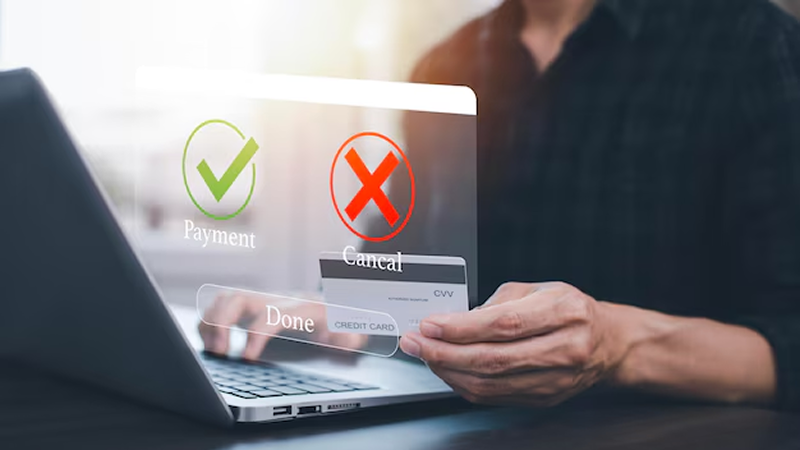
Checkout validation is the process of confirming that real users can complete real payments under real-world conditions. It is not limited to verifying that APIs respond or that fields validate correctly. It is about confirming that customers understand the flow, trust what they see, and successfully complete a purchase without confusion or frustration.
Traditional functional checkout testing answers the question: Does the system work?
Real-world checkout validation answers the question: Does the experience make sense to users?
Automation cannot hesitate, misinterpret instructions, or abandon a payment when something feels suspicious. It cannot simulate how a customer reacts when their bank app looks unfamiliar or when an error message is poorly translated. Humans can, and they do, thousands of times every day.
This is why teams often launch with perfect test results and still watch conversion fall. The checkout technically works. The experience does not.
The Real Risks of Launching Without Global Checkout Validation
The consequences of poor checkout validation are rarely dramatic on day one. They emerge quietly, spread across markets, teams, and metrics, and by the time they are visible, revenue and trust have already been lost.
Without global checkout validation, teams commonly face:
- Lost revenue from cart abandonment
Users reach the final step, encounter friction, confusion, or failure, and leave without completing payment. - Failed payments despite “green” test results
Automated tests pass, APIs respond correctly, yet real transactions fail due to bank behavior, redirects, or authentication flows. - Country-specific payment issues
Local cards, wallets, or bank transfers fail only in certain regions, often due to routing rules, regulations, or issuer quirks. - Conversion drops in new markets
Marketing drives traffic, but checkout performance lags behind expectations, masking payment failures as “low demand.” - Increased refund processing costs
Payments are approved, but orders are not created, forcing manual refunds and reconciliation. - Customer support overload and brand damage
Support teams receive vague complaints like “payment didn’t go through,” while brand trust erodes at the most sensitive moment. - Loss of trust at the most critical funnel step
Users do not experiment with unfamiliar checkouts. A single failed attempt is often the last. - Third-party dependency failures
Issues in gateways, wallets, banks, or authentication services surface only in production, leaving teams reacting instead of preventing.
These risks are difficult to diagnose because they do not point to a single system or owner. Marketing blames traffic quality. Product blames the gateway. Engineering sees no errors. Meanwhile, real users quietly abandon.
Once trust is lost at the moment of payment, the damage is hard to reverse. Customers simply choose competitors who make paying feel safe.
Global Checkout Validation Checklist
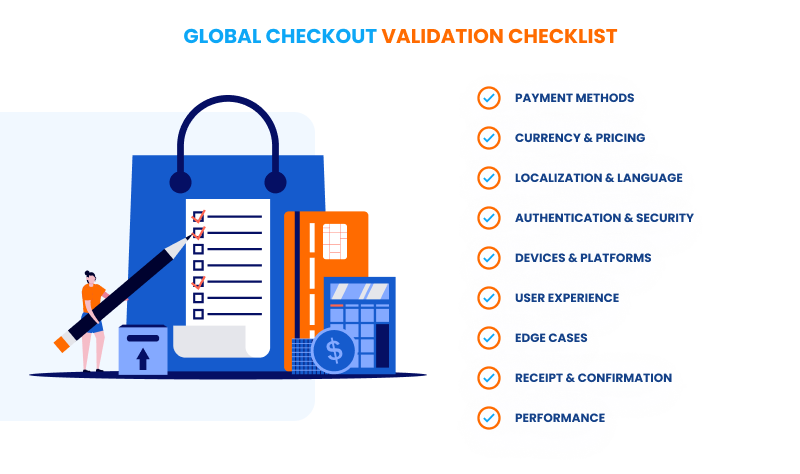
Payment Methods
Every market has its own payment culture. Some countries rely heavily on cards, others on wallets, and others on instant bank transfers. Validation must ensure that locally preferred methods are not only available but fully functional with real issuing banks, real wallets, and real redirect behaviour.
If users do not see their preferred way to pay, or if it fails, they abandon without hesitation.
Currency & Pricing
Money is emotional. Users instinctively check whether prices look familiar and consistent. Validation ensures that currency symbols, separators, rounding rules, taxes, and fees behave correctly and that nothing changes unexpectedly between cart and checkout.
Small inconsistencies here are interpreted as risk.
Localization & Language
Checkout copy is not content; it is an instruction. Poorly translated payment messages create hesitation at exactly the wrong moment. Validation ensures that terminology is culturally aligned and that error messages guide users instead of alarming them.
Authentication & Security
Authentication is where many global checkouts collapse. Banks differ dramatically in how they implement 3DS, biometrics, and fallback flows. Validation must confirm that users understand what is happening, can complete the process, and reliably return to the merchant.
A secure flow that confuses users is effectively broken.
Devices & Platforms
Global users are not using the same devices as your development team. Validation must include older phones, regionally popular models, in-app browsers, and fragmented OS environments. Many payment bugs exist only here, invisible in controlled testing.
User Experience
Checkout should feel inevitable, not risky. Validation focuses on clarity, predictability, and recovery. Users must always know what will happen when they click “Pay,” and how to proceed if something fails.
Edge Cases
Most real checkouts are interrupted by poor networks, calls, refreshes, or simple impatience. Validation ensures that the system handles these moments gracefully instead of breaking or charging users incorrectly.
Receipt & Confirmation
Payment is not complete until users feel it is. Validation ensures that every transaction results in a clear confirmation screen, receipt, and notification. Missing confirmation destroys trust even when money has been taken.
Performance
Checkout must remain responsive during spikes, throttling, or partial outages. Validation under realistic conditions ensures that growth does not become its own bottleneck.
Crowd Testing for Global Checkout Validation

Crowd testing is a testing approach that uses real users from real markets with real local payment methods to validate how a product behaves in real-life conditions and real transactions.
Instead of relying on simulated environments or internal QA teams, crowd testing involves people using their own devices, payment methods, banks, operating systems, and network conditions in their actual countries. Crowd testing turns checkout validation into a reality check.
Instead of simulating behaviour, real people from specific countries perform real transactions using their own banks, wallets, devices, and networks. They record videos of the entire journey, capture screenshots, submit error logs, and describe exactly where they hesitated or felt unsure.
Behind every effective crowd testing initiative is a dedicated project manager (PM) who orchestrates the entire process end-to-end. The PM defines scenarios, selects the right tester profiles by country and payment method, coordinates execution, validates findings, and consolidates results into clear, actionable insights. This removes operational and coordination overhead from the client’s team, allowing product, engineering, and payments stakeholders to focus on fixing issues rather than managing testers, timelines, or data quality.
This approach reveals issues automation cannot: cultural misunderstandings, wallet failures tied to OS builds, confusing authentication language, or usability problems on locally dominant devices.
Within 24–48 hours, teams receive not just pass/fail results, but a map of how their checkout truly performs around the world.
When to Run Checkout Validation
Run checkout validation at critical moments in your go-to-market lifecycle:
- Before entering new markets to confirm local payment methods, banks, and user behaviour
- Before adding new payment methods (wallets, BNPL, bank transfers, local schemes)
- After major checkout UI or flow changes, including authentication and redirects
- Before high-traffic campaigns or seasonal peaks, where failure is amplified
Treat checkout validation as a core go-to-market activity, not a QA checkbox.
Common Pitfalls to Avoid
Teams often lose revenue by making avoidable assumptions:
- Validating only cards in wallet-first or bank-transfer-driven markets
- Testing desktop only in regions where mobile dominates
- Skipping failure and interruption scenarios entirely
- Postponing localization, compliance, or authentication flows until after launch
These shortcuts rarely fail loudly; they surface later as lower conversion, support tickets, and lost trust.
Common Issues Found Through Crowd Testing
Crowd testing consistently exposes failures that traditional QA and automation simply cannot detect in global payment flows:
- Payments are successfully approved by banks, while orders are never created on the merchant side
- Local cards and wallets are rejected incorrectly due to routing, BIN logic, or regional rules
- Endless authentication loops caused by specific issuing banks or 3DS implementations
Confirmation screens, error messages, or redirects are shown in the wrong language or currency - Wallets and redirects are failing only on specific OS versions, device models, or in-app browsers
What makes these issues dangerous is not their rarity; it is their invisibility.
They do not appear in staging, sandbox, or synthetic tests. They surface only when real customers attempt real payments in real conditions.
Without crowd testing, teams often ship global checkouts that are technically correct but commercially broken. With crowd testing, these failures are identified before customers lose trust, abandon, or churn.
Conclusion: From Assumptions to Confidence
Global checkout validation is not optional. It is the foundation of international growth.
Checkout is the most fragile and valuable step in your funnel, and every untested assumption becomes a silent conversion leak. A checkout can be technically correct and still fail when real users attempt to pay under real-world conditions.
Crowd testing removes this risk by validating checkout flows with real users in real markets, using their own banks, wallets, devices, and networks. It reveals where trust breaks, payments fail, or users hesitate before those issues reach customers.
In global commerce, confidence is earned at the moment of payment. Crowd testing ensures that the moment works everywhere you operate.
Validate your global checkout with real users before your customers do. Discover how crowd testing uncovers hidden payment failures, authentication issues, and trust gaps across markets. Explore crowd testing for payment validation.